
01
What matters
The Social Security payroll-tax earnings cap will rise to $192,300 in 2027, according to CNBC, raising the earnings threshold that applies to workers and employers. Separately, CNBC reports that the temporary senior tax deduction applies through tax year 2028; lawmakers may decide whether to extend it.
02
Verified facts
- CNBC published its report on Nov. 15, 2026, at 9:30 a.m. EST.
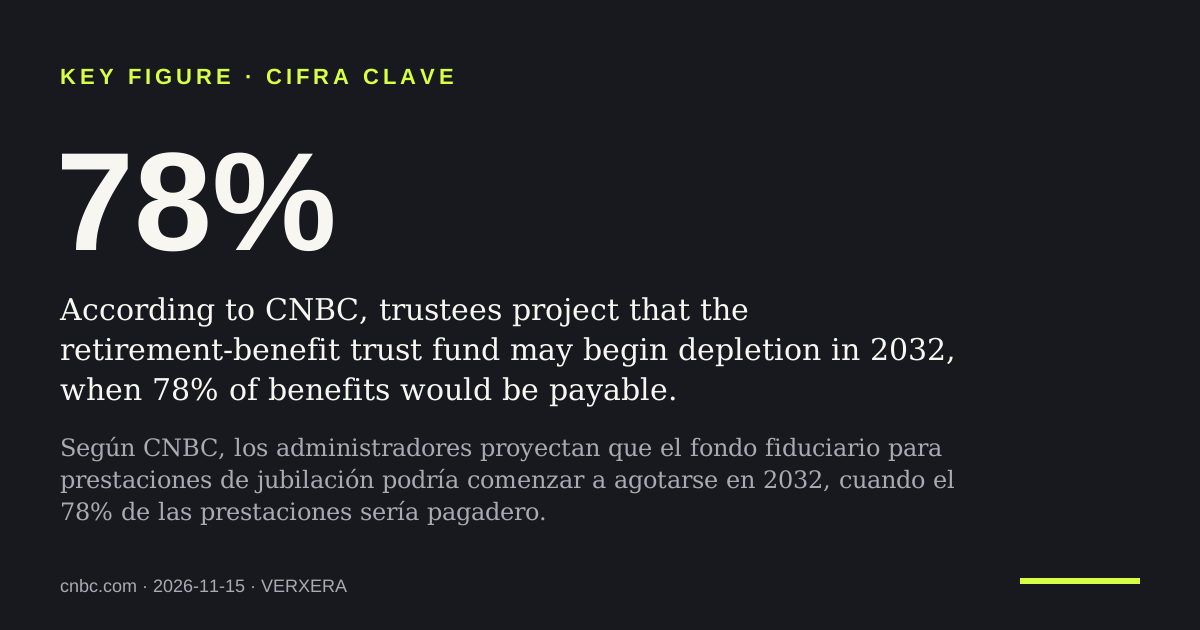
- According to CNBC, trustees project that the retirement-benefit trust fund may begin depletion in 2032, when 78% of benefits would be payable.
- CNBC reports that combining the retirement and disability trust funds would push depletion to 2034, when 83% of scheduled benefits would be payable.
- For 2026, CNBC says earnings up to $184,500 are subject to Social Security payroll tax, with workers and employers each contributing 6.2% up to that threshold.
- The wage cap will rise to $192,300 in 2027, according to CNBC.
- CNBC describes the senior tax deduction as up to $6,000 per individual.
- The deduction is in effect for tax years 2025 through 2028, CNBC reports.
- CNBC says lawmakers elected in the midterms may decide whether to extend the temporary tax break.
03
Analysis
CNBC’s account distinguishes a dated payroll-tax cap increase from a possible extension of a temporary deduction. The cap concerns taxable earnings and contributions from workers and employers; the deduction has a maximum per individual and a defined tax-year window. The trust-fund projections describe different scopes: retirement benefits alone in 2032, and combined retirement and disability funds in 2034. Neither projection is a measure of current benefit payments.
04 · VERXERA view
Editorial opinionVERXERA opinion: CNBC’s account supports treating the payroll-tax cap increase and the senior deduction’s future as separate developments, not one settled tax-policy change. The cap rises from $184,500 in 2026 to $192,300 in 2027, while workers and employers each contribute 6.2% up to the threshold. The deduction is up to $6,000 per individual for tax years 2025 through 2028; its extension remains an open legislative question. Connecting those facts matters because a specified threshold change and a possible continuation of tax relief have different degrees of certainty. The projection that 78% of retirement benefits would be payable in 2032 provides longer-term context, not a measured outcome of either provision. This account rests on CNBC’s report alone. Deeper source reading is worthwhile to distinguish the dated provisions from the unresolved extension.
This is VERXERA’s editorial interpretation, separated from the facts and analysis above. The reader keeps the final judgment.
05
Counterevidence and limits
This account rests on CNBC’s report; the figures, dates and description of possible legislative action are its statements.
06
Known uncertainties
Whether lawmakers will extend the senior deduction beyond tax year 2028 remains unresolved.
01
Lo que importa
El tope de ingresos sujetos al impuesto sobre la nómina del Seguro Social subirá a $192,300 en 2027, según CNBC, elevando el umbral aplicable a trabajadores y empleadores. Por separado, CNBC informa que la deducción temporal para mayores se aplica hasta el año fiscal 2028; los legisladores podrían decidir si la prorrogan.
02
Hechos verificados
- CNBC publicó su informe el 15 de noviembre de 2026 a las 9:30 a. m., hora estándar del este de Estados Unidos (EST).
- Según CNBC, los administradores proyectan que el fondo fiduciario para prestaciones de jubilación podría comenzar a agotarse en 2032, cuando el 78% de las prestaciones sería pagadero.
- CNBC informa que combinar los fondos fiduciarios de jubilación y discapacidad aplazaría el agotamiento hasta 2034, cuando el 83% de las prestaciones programadas sería pagadero.
- Para 2026, CNBC señala que los ingresos de hasta $184,500 están sujetos al impuesto sobre la nómina del Seguro Social; trabajadores y empleadores aportan cada uno el 6.2% hasta ese umbral.
- El tope salarial subirá a $192,300 en 2027, según CNBC.
- CNBC describe la deducción fiscal para mayores como una deducción de hasta $6,000 por individuo.
- La deducción está vigente durante los años fiscales 2025 a 2028, informa CNBC.
- CNBC señala que los legisladores elegidos en los comicios de mitad de mandato podrían decidir si prorrogan el beneficio fiscal temporal.
03
Análisis
El informe de CNBC distingue un aumento fechado del tope del impuesto sobre la nómina de una posible prórroga de una deducción temporal. El tope corresponde a ingresos gravables y aportaciones de trabajadores y empleadores; la deducción tiene un máximo por individuo y un período fiscal definido. Las proyecciones de los fondos tienen alcances distintos: jubilación solamente en 2032 y fondos combinados de jubilación y discapacidad en 2034. Ninguna mide los pagos actuales de prestaciones.
04 · Opinión VERXERA
Opinión editorialOpinión de VERXERA: El informe de CNBC permite tratar el aumento del tope y el futuro de la deducción como asuntos separados, no como un único cambio tributario resuelto. El tope sube de $184,500 en 2026 a $192,300 en 2027; trabajadores y empleadores aportan cada uno el 6.2% hasta ese umbral. La deducción alcanza hasta $6,000 por individuo durante los años fiscales 2025 a 2028; su prórroga sigue pendiente. Relacionar estos datos importa porque un cambio definido del umbral y una posible continuidad del alivio fiscal tienen distintos grados de certeza. La proyección de que el 78% de las prestaciones de jubilación sería pagadero en 2032 aporta contexto, no un resultado medido de esas disposiciones. Este relato descansa únicamente en el informe de CNBC. Profundizar en la fuente resulta útil para distinguir las disposiciones fechadas de la prórroga aún pendiente.
Esta es la interpretación editorial de VERXERA, separada de los hechos y del análisis anteriores. El lector conserva la decisión final.
05
Contraste y límites
Este relato se basa en el informe de CNBC; las cifras, fechas y descripción de posibles decisiones legislativas corresponden a lo que ese medio afirma.
06
Incertidumbres conocidas
Sigue sin resolverse si los legisladores prorrogarán la deducción para mayores más allá del año fiscal 2028.