

01
What matters
ECB Vice-President Boris Vujčić called for more market-based finance in Europe alongside stronger safeguards, linking the proposed expansion of non-bank finance to protections against system-wide risks. His November 16, 2026, speech highlighted broader AI-related vulnerabilities and increased sovereign-debt fragilities.
02
Verified facts
- According to the ECB, Vice-President Boris Vujčić delivered the keynote speech at Euro Finance Week in Frankfurt am Main on November 16, 2026.
- Vujčić said Europe needs more market-based finance and that a larger role for non-bank financial institutions must come with stronger system-wide safeguards.
- The speech described AI-related financial-stability risks extending beyond potential market repricing to increased debt-market funding, concentrated exposures, faster AI adoption and potential cyberattacks.
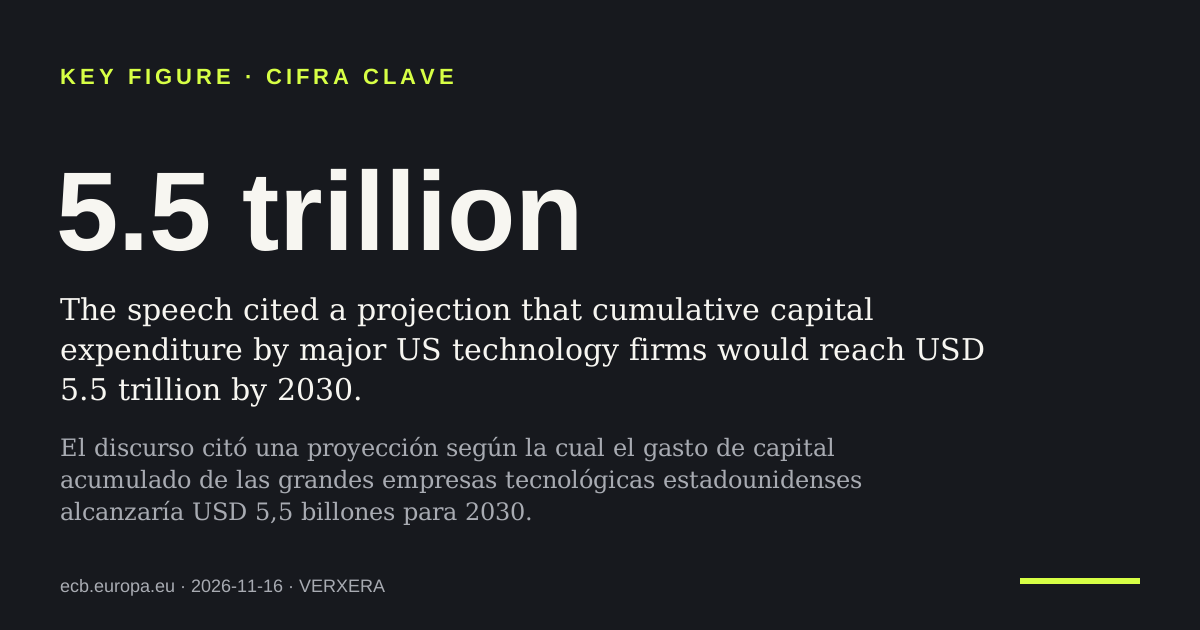
- The speech cited a projection that cumulative capital expenditure by major US technology firms would reach USD 5.5 trillion by 2030.
- Vujčić said sovereign-debt fragilities had increased on both sides of the Atlantic and were among the factors pushing long-term yields higher.
- Vujčić described tools for addressing systemic risks in non-bank finance as limited. He called for stronger EU-level supervision and an approach covering the financial system as a whole.
- For investment funds, Vujčić called for redemption terms to align more closely with the liquidity of underlying assets, addressing structural mismatches between investor withdrawals and asset liquidity.
03
Analysis
The speech pairs a financing objective with a supervisory recommendation: expand market-based finance while strengthening safeguards for non-banks. Its investment-fund recommendation concerns the relationship between withdrawal terms and asset liquidity. These are policy proposals, not reported results of their implementation. The USD 5.5 trillion figure is projected cumulative capital expenditure through 2030 by major US technology firms, not a measure of euro-area financial losses or non-bank exposures.
04 · VERXERA view
Editorial opinionVERXERA opinion: The speech’s central distinction matters: support for more market-based finance is coupled with a call for stronger safeguards, rather than presented as a substitute for them. Its projection of USD 5.5 trillion in cumulative capital expenditure by major US technology firms by 2030 gives scale to the financing discussion; its warning about limited non-bank risk tools identifies the policy concern. These statements connect financing needs and supervisory capacity without measuring a resulting loss. The strongest limitation is that projected expenditure does not quantify financial-system exposure or establish that instability will follow. A closer reading is worthwhile for understanding Vujčić’s proposed safeguards, not for estimating losses from the projection.
This is VERXERA’s editorial interpretation, separated from the facts and analysis above. The reader keeps the final judgment.
05
Counterevidence and limits
This account rests on the ECB’s published speech; the risk assessments, projection and policy recommendations are Vujčić’s statements.
06
Known uncertainties
The safeguard recommendations do not specify an implementation timetable or detailed requirements.
01
Lo que importa
El vicepresidente del BCE, Boris Vujčić, pidió ampliar la financiación de mercado en Europa junto con sus salvaguardas, vinculando el crecimiento propuesto de la financiación no bancaria con protecciones frente a riesgos sistémicos. En su discurso del 16 de noviembre de 2026 destacó vulnerabilidades más amplias relacionadas con la IA y mayores fragilidades de la deuda soberana.
02
Hechos verificados
- Según el BCE, su vicepresidente, Boris Vujčić, pronunció el discurso inaugural de Euro Finance Week en Fráncfort del Meno el 16 de noviembre de 2026.
- Vujčić afirmó que Europa necesita más financiación de mercado y que un mayor papel de las entidades financieras no bancarias debe acompañarse de salvaguardas sistémicas más sólidas.
- El discurso describió riesgos de la IA para la estabilidad financiera que van más allá de una posible corrección de precios: mayor financiación mediante deuda, exposiciones concentradas, adopción más rápida de la IA y posibles ciberataques.
- El discurso citó una proyección según la cual el gasto de capital acumulado de las grandes empresas tecnológicas estadounidenses alcanzaría USD 5,5 billones para 2030.
- Vujčić afirmó que las fragilidades de la deuda soberana habían aumentado a ambos lados del Atlántico y figuraban entre los factores que elevaban los rendimientos a largo plazo.
- Vujčić calificó de limitadas las herramientas para abordar los riesgos sistémicos de la financiación no bancaria. Pidió reforzar la supervisión en la UE y adoptar un enfoque que abarque todo el sistema financiero.
- Para los fondos de inversión, Vujčić pidió ajustar mejor las condiciones de reembolso a la liquidez de los activos subyacentes, abordando los desajustes estructurales entre los retiros de los inversores y la liquidez de los activos.
03
Análisis
El discurso combina un objetivo de financiación con una recomendación supervisora: ampliar la financiación de mercado y reforzar las salvaguardas para las entidades no bancarias. La recomendación para los fondos relaciona las condiciones de retiro con la liquidez de los activos. Son propuestas, no resultados de su aplicación. Los USD 5,5 billones representan gasto de capital acumulado proyectado de grandes tecnológicas estadounidenses hasta 2030, no pérdidas financieras ni exposiciones no bancarias de la zona del euro.
04 · Opinión VERXERA
Opinión editorialOpinión de VERXERA: La distinción central del discurso importa: el apoyo a más financiación de mercado se acompaña de mayores salvaguardas, no las sustituye. La proyección de USD 5,5 billones de gasto de capital acumulado de grandes tecnológicas estadounidenses para 2030 dimensiona la discusión sobre financiación; la advertencia sobre las limitadas herramientas para riesgos no bancarios identifica la preocupación regulatoria. Ambas afirmaciones conectan necesidades de financiación y capacidad supervisora sin medir pérdidas resultantes. La principal limitación es que el gasto proyectado no cuantifica la exposición del sistema financiero ni demuestra que vaya a producirse inestabilidad. Una lectura más detenida sirve para comprender las salvaguardas propuestas por Vujčić, no para estimar pérdidas a partir de esa proyección.
Esta es la interpretación editorial de VERXERA, separada de los hechos y del análisis anteriores. El lector conserva la decisión final.
05
Contraste y límites
Esta información se basa en el discurso publicado por el BCE; las evaluaciones de riesgos, la proyección y las recomendaciones son declaraciones de Vujčić.
06
Incertidumbres conocidas
Las recomendaciones sobre salvaguardas no especifican un calendario de aplicación ni requisitos detallados.