01
What matters
U.S. employers added 165,000 jobs in October 2026 and unemployment dipped to 4.1%, according to the Associated Press, published by PBS NewsHour, and CNBC. Hiring exceeded economists’ expectations. The wage figures offer a more qualified picture: CNBC reported annual earnings growth below its cited inflation reading, although the two measures cover different months.
02
Verified facts
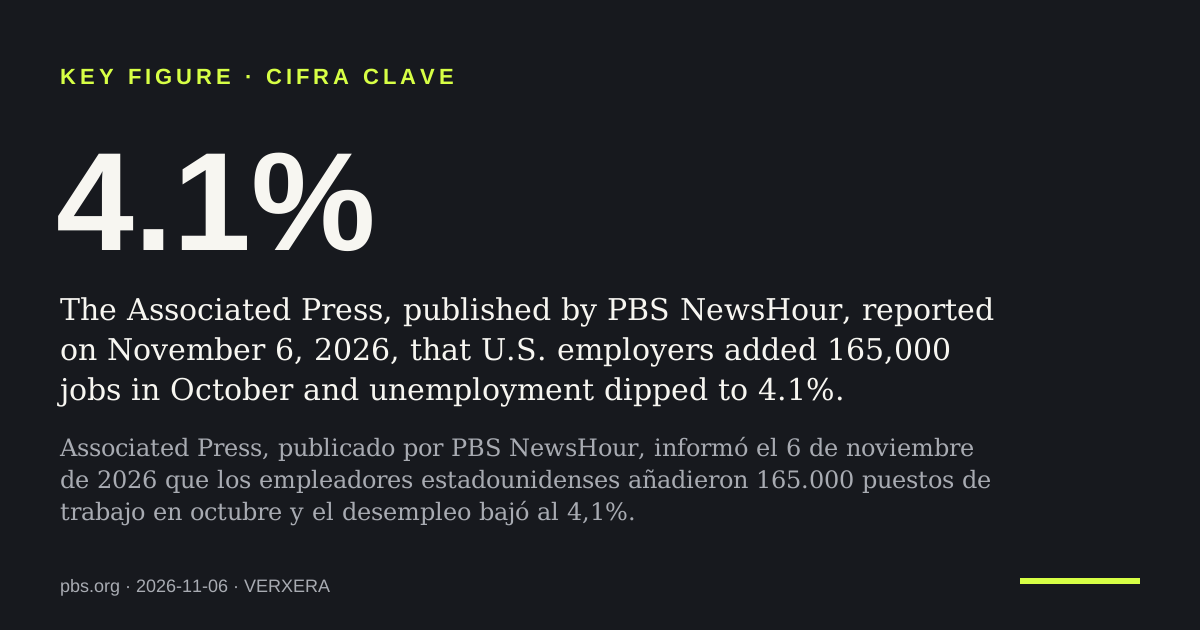
- The Associated Press, published by PBS NewsHour, reported on November 6, 2026, that U.S. employers added 165,000 jobs in October and unemployment dipped to 4.1%.
- The Associated Press, published by PBS NewsHour, reported that economists had expected 65,000 new jobs in October, substantially below the reported gain. That expectation figure comes from this account alone.
- The Associated Press, published by PBS NewsHour, alone reported that average hourly wages rose 0.4% in October from September.
- The Associated Press, published by PBS NewsHour, reported that hourly wages rose 3.1% from October 2025 and said many workers had lost purchasing power over the year despite continued hiring.
- CNBC also reported that the U.S. economy added 165,000 jobs in October and unemployment edged lower to 4.1%.
- CNBC reported that average hourly earnings increased 3.1% annually in October, compared with September consumer price index inflation of 3.7%.
- CNBC reported that San Francisco Federal Reserve President Mary Daly expected further policy tightening, while saying its timing and amount remained undecided.
03
Analysis
The employment figures describe stronger-than-expected October hiring; they do not establish that workers’ purchasing power improved. Monthly wage growth and annual wage growth also measure different intervals. CNBC’s inflation comparison supplies relevant context, not a same-month calculation of inflation-adjusted earnings. Daly’s expectation is policy context rather than an announced decision, and it does not establish that the jobs figures caused a policy change.
04 · VERXERA view
Editorial opinionVERXERA opinion: October’s figures support a clear conclusion about hiring, not an equally clear conclusion about living standards. The 165,000 jobs reported by both news accounts exceeded the 65,000 expected in the Associated Press, published by PBS NewsHour, account, while unemployment fell to 4.1%. That strength matters alongside wages: the same account reported a 0.4% monthly increase in October, and CNBC reported 3.1% annual earnings growth against September CPI inflation of 3.7%. Together, these figures explain why employment gains and purchasing-power concerns can coexist. The strongest limitation is the mismatch between the wage and inflation months; it prevents a precise October real-wage conclusion. Deeper source reading is worthwhile for distinguishing hiring strength from wage purchasing power and an official’s policy expectation from a settled decision.
This is VERXERA’s editorial interpretation, separated from the facts and analysis above. The reader keeps the final judgment.
05
Counterevidence and limits
The wage–inflation comparison pairs October annual earnings growth with September annual CPI inflation, limiting conclusions about October purchasing power.
06
Known uncertainties
The timing and amount of further policy tightening remained undecided. The report reflects the accounts as of November 6, 2026; later developments are outside its scope.
01
Lo que importa
Los empleadores estadounidenses añadieron 165.000 puestos de trabajo en octubre de 2026 y el desempleo bajó al 4,1%, según Associated Press, publicado por PBS NewsHour, y CNBC. La contratación superó las expectativas de los economistas. Los salarios ofrecen un panorama más matizado: CNBC informó de un crecimiento salarial anual inferior a la inflación que citó, aunque ambas mediciones corresponden a meses distintos.
02
Hechos verificados
- Associated Press, publicado por PBS NewsHour, informó el 6 de noviembre de 2026 que los empleadores estadounidenses añadieron 165.000 puestos de trabajo en octubre y el desempleo bajó al 4,1%.
- Associated Press, publicado por PBS NewsHour, informó que los economistas esperaban 65.000 nuevos empleos en octubre, una cifra considerablemente inferior al aumento registrado. Esa expectativa procede únicamente de esta crónica.
- Associated Press, publicado por PBS NewsHour, fue el único de estos medios que informó que los salarios medios por hora aumentaron un 0,4% en octubre respecto de septiembre.
- Associated Press, publicado por PBS NewsHour, informó que los salarios por hora aumentaron un 3,1% respecto de octubre de 2025 y señaló que muchos trabajadores habían perdido poder adquisitivo durante el año pese a la contratación continuada.
- CNBC también informó que la economía estadounidense añadió 165.000 empleos en octubre y que el desempleo bajó al 4,1%.
- CNBC informó que los ingresos medios por hora aumentaron un 3,1% interanual en octubre, frente a una inflación del índice de precios al consumidor del 3,7% en septiembre.
- CNBC informó que Mary Daly, presidenta de la Reserva Federal de San Francisco, esperaba un mayor endurecimiento monetario, aunque su calendario y magnitud seguían sin decidirse.
03
Análisis
Las cifras de empleo describen una contratación en octubre superior a la esperada; no demuestran que mejorara el poder adquisitivo de los trabajadores. El crecimiento salarial mensual y el anual también abarcan intervalos distintos. La comparación de inflación de CNBC aporta contexto pertinente, no un cálculo del salario ajustado por inflación para el mismo mes. La expectativa de Daly constituye contexto monetario, no una decisión anunciada, y no demuestra que las cifras laborales causaran un cambio de política.
04 · Opinión VERXERA
Opinión editorialOpinión de VERXERA: Las cifras de octubre permiten una conclusión clara sobre la contratación, no una igualmente clara sobre el nivel de vida. Los 165.000 empleos publicados por ambos medios superaron los 65.000 previstos en la crónica de Associated Press, publicado por PBS NewsHour, mientras el desempleo bajó al 4,1%. Esa fortaleza importa junto con los salarios: esa crónica registró un aumento mensual del 0,4% en octubre, y CNBC situó el crecimiento salarial anual en el 3,1%, frente a una inflación del IPC del 3,7% en septiembre. Las cifras explican por qué pueden coexistir avances laborales e inquietudes sobre el poder adquisitivo. La principal limitación es comparar meses distintos, lo que impide concluir con precisión sobre el salario real de octubre. Profundizar en las fuentes permite distinguir contratación, poder adquisitivo y expectativas monetarias de decisiones firmes.
Esta es la interpretación editorial de VERXERA, separada de los hechos y del análisis anteriores. El lector conserva la decisión final.
05
Contraste y límites
La comparación salarial y de inflación combina el crecimiento interanual de los ingresos de octubre con la inflación interanual del IPC de septiembre, lo que limita las conclusiones sobre el poder adquisitivo de octubre.
06
Incertidumbres conocidas
El calendario y la magnitud de un mayor endurecimiento monetario seguían sin decidirse. El informe refleja las crónicas al 6 de noviembre de 2026; los acontecimientos posteriores quedan fuera de su alcance.