
01
What matters
Bank of England chief economist Huw Pill said interest rates would probably need to rise in December 2026 and again in early 2027, keeping further increases in view after the move to 4%, The Guardian reported on 14 November. The article dates that completed increase inconsistently: its body places it earlier in November, while its subheadline places it in October. Pill’s outlook is not another Bank decision.
02
Verified facts
- The Guardian reported on 14 November 2026 that Pill said the Bank would probably need to raise interest rates the following month, December 2026.
- The Guardian reported that rates might need to rise again in early 2027 to combat rising inflation.
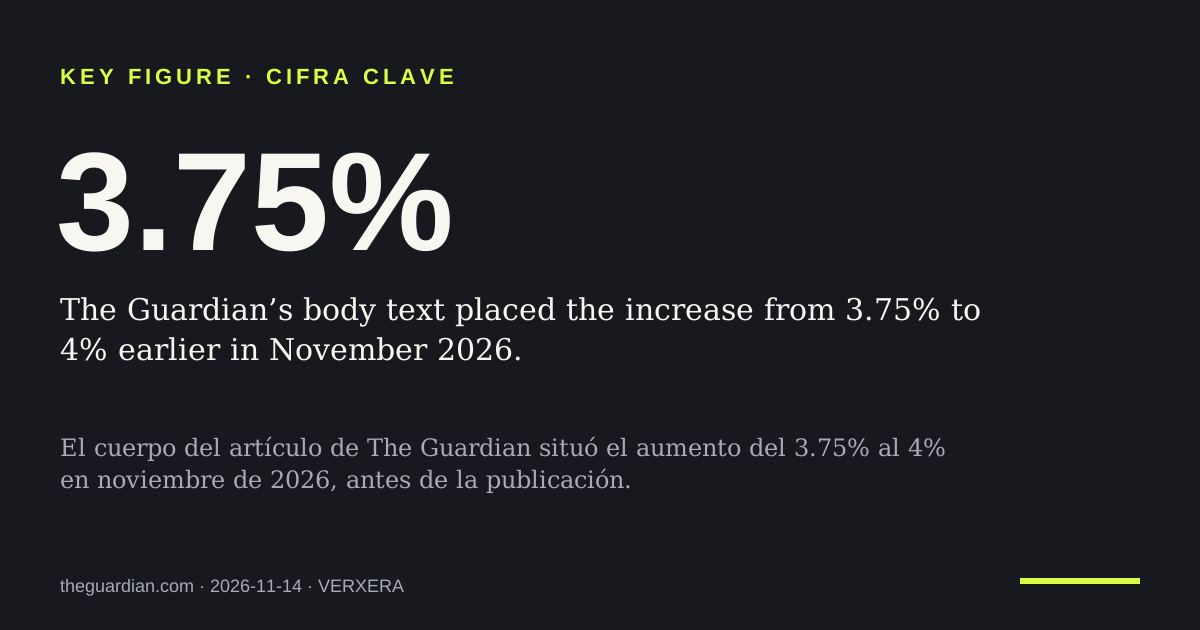
- The Guardian’s body text placed the increase from 3.75% to 4% earlier in November 2026.
- The Guardian’s subheadline instead placed the increase to 4% in the previous month, October 2026.
- The Guardian reported that Pill was poised to vote for another quarter-percentage-point increase in December. This described his indicated vote, not a Bank decision.
- According to The Guardian, the Bank’s next interest-rate decision was due on 17 December 2026.
03
Analysis
The report separates a completed increase from Pill’s expectations for subsequent decisions. It gives a size for his indicated December vote—a quarter percentage point—not an agreed outcome for the Bank. The 17 December 2026 decision is therefore the next dated milestone in this account. The reported prospect of another increase in early 2027 does not establish its size or precise timing.
04 · VERXERA view
Editorial opinionVERXERA opinion: The significant signal is that Pill envisaged further increases after the reported move from 3.75% to 4%, rather than treating that move as the endpoint. His indicated vote for another quarter-percentage-point increase in December 2026, alongside the decision scheduled for 17 December, gives that outlook a concrete scale and near-term reference. The distinction matters: an official’s intended vote is not a decision by the Bank. This account rests on The Guardian’s report alone, and its conflicting November and October datings limit the precision of the chronology. Deeper source reading is worthwhile for understanding Pill’s indicated direction and timing, not for treating a further increase as settled policy.
This is VERXERA’s editorial interpretation, separated from the facts and analysis above. The reader keeps the final judgment.
05
Counterevidence and limits
The Guardian’s body dates the increase to 4% to earlier in November 2026; its subheadline dates it to October 2026.
06
Known uncertainties
Whether the Bank will raise rates on 17 December 2026 remains open, as do the size and timing of any increase in early 2027. The article’s conflicting dates leave the month of the completed increase unclear.
01
Lo que importa
Huw Pill, economista jefe del Banco de Inglaterra, dijo que probablemente sería necesario subir los tipos en diciembre de 2026 y nuevamente a principios de 2027, manteniendo la perspectiva de nuevas alzas tras el aumento al 4%, informó The Guardian el 14 de noviembre. El artículo fecha ese aumento de forma contradictoria: el cuerpo lo sitúa en noviembre, antes de su publicación, y el subtítulo en octubre. La perspectiva de Pill no constituye otra decisión del Banco.
02
Hechos verificados
- The Guardian informó el 14 de noviembre de 2026 que Pill dijo que probablemente sería necesario subir los tipos de interés el mes siguiente, diciembre de 2026.
- The Guardian informó que podría ser necesario volver a subir los tipos a principios de 2027 para combatir el aumento de la inflación.
- El cuerpo del artículo de The Guardian situó el aumento del 3.75% al 4% en noviembre de 2026, antes de la publicación.
- El subtítulo de The Guardian situó, en cambio, el aumento al 4% en el mes anterior, octubre de 2026.
- The Guardian informó que Pill se disponía a votar por otro aumento de un cuarto de punto porcentual en diciembre. Esto describía el sentido previsto de su voto, no una decisión del Banco.
- Según The Guardian, la próxima decisión del Banco sobre los tipos de interés estaba prevista para el 17 de diciembre de 2026.
03
Análisis
El artículo distingue un aumento ya realizado de las expectativas de Pill para decisiones posteriores. Especifica la magnitud del alza que se disponía a apoyar en diciembre —un cuarto de punto porcentual—, no un resultado acordado por el Banco. La decisión del 17 de diciembre de 2026 es, por tanto, el siguiente hito fechado de este relato. La perspectiva de otra subida a principios de 2027 no establece su magnitud ni su fecha precisa.
04 · Opinión VERXERA
Opinión editorialOpinión de VERXERA: La señal relevante es que Pill contemplaba nuevas subidas tras el aumento reportado del 3.75% al 4%, en lugar de considerar esa medida como el punto final. Su disposición a votar por otro incremento de un cuarto de punto porcentual en diciembre de 2026, junto con la decisión prevista para el 17 de diciembre, da a esa perspectiva una magnitud concreta y una referencia próxima. La distinción importa: la intención de voto de un funcionario no equivale a una decisión del Banco. Este relato depende únicamente de The Guardian, cuyas fechas contradictorias de noviembre y octubre limitan la precisión cronológica. Una lectura más profunda permite entender la dirección y el calendario indicados por Pill, no considerar decidida otra subida.
Esta es la interpretación editorial de VERXERA, separada de los hechos y del análisis anteriores. El lector conserva la decisión final.
05
Contraste y límites
El cuerpo del artículo de The Guardian sitúa el aumento al 4% en noviembre de 2026, antes de la publicación; su subtítulo lo fecha en octubre de 2026.
06
Incertidumbres conocidas
Sigue abierto si el Banco subirá los tipos el 17 de diciembre de 2026, así como la magnitud y la fecha de cualquier aumento a principios de 2027. Las fechas contradictorias del artículo dejan sin aclarar el mes del aumento ya realizado.