
01
What matters
U.S. consumer prices rose a seasonally adjusted 0.4% in October 2026, above economists’ 0.3% expectation, CNBC reported, putting the monthly increase above the forecast benchmark. CNBC and CBS reported core inflation of 0.3% and no overall year-over-year rate because October 2025 comparison data were unavailable following the shutdown.
02
Verified facts
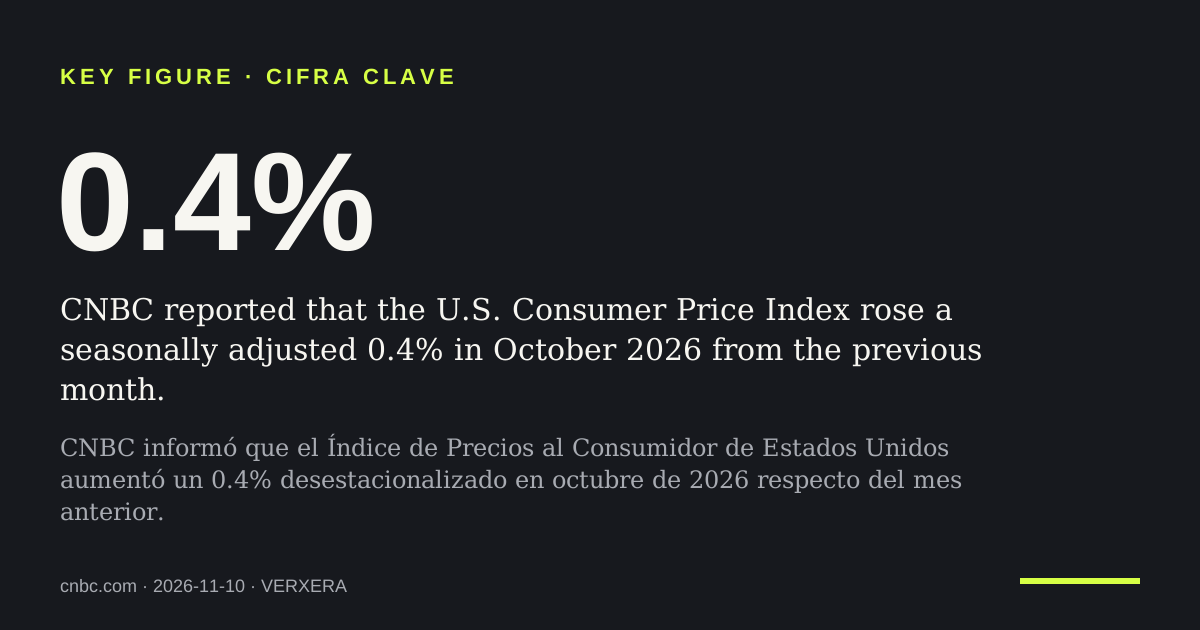
- CNBC reported that the U.S. Consumer Price Index rose a seasonally adjusted 0.4% in October 2026 from the previous month.
- Economists surveyed by Dow Jones had expected a 0.3% monthly increase, according to CNBC.
- CNBC reported that core CPI, which excludes food and energy, increased 0.3% in October.
- According to CNBC, the Bureau of Labor Statistics did not estimate an annual inflation rate for October because the 2025 shutdown prevented sufficient collection of October 2025 comparison data.
- CBS reported that October core inflation increased 0.3%, matching September’s monthly rate and slightly exceeding economists’ forecasts.
- CBS reported that the Labor Department omitted the October 2026 year-over-year inflation rate because the 2025 shutdown left it without October 2025 consumer-price data for comparison.
03
Analysis
The comparisons answer different questions. CNBC’s 0.4% monthly headline increase exceeded the 0.3% forecast. CBS’s comparison places the 0.3% core increase alongside the same monthly rate in September. Neither comparison supplies the missing annual measure described by both outlets; the reported monthly readings and the unavailable year-over-year reading must remain distinct.
04 · VERXERA view
Editorial opinionVERXERA opinion: The evidence supports a narrow conclusion: October’s monthly inflation reading exceeded expectations, while the annual comparison remained unavailable. CNBC’s reported 0.4% seasonally adjusted U.S. CPI increase for October 2026, against a 0.3% monthly forecast, establishes the forecast comparison. The 0.3% core increase reported by CNBC and CBS adds a measure excluding food and energy; CBS also places it level with September’s monthly rate. Together, these figures make the monthly result meaningful without establishing a broader annual trend. The strongest limitation is the missing October 2025 baseline, which both outlets link to the shutdown. Deeper source reading is worthwhile for understanding those distinct comparisons, not for treating the monthly figures as a substitute for the unavailable annual rate.
This is VERXERA’s editorial interpretation, separated from the facts and analysis above. The reader keeps the final judgment.
05
Counterevidence and limits
CBS’s report that core inflation matched September’s 0.3% monthly rate limits any interpretation that the October core reading represented an acceleration from that month.
06
Known uncertainties
The October 2026 year-over-year inflation rate is unavailable because of the missing October 2025 comparison data, according to CNBC and CBS.
01
Lo que importa
Los precios al consumidor en Estados Unidos subieron un 0.4% desestacionalizado en octubre de 2026, por encima del 0.3% previsto por los economistas, informó CNBC: el aumento mensual superó así la referencia de las previsiones. CNBC y CBS reportaron una inflación subyacente del 0.3% y la ausencia de una tasa interanual general por la falta de datos comparables de octubre de 2025 tras el cierre del Gobierno.
02
Hechos verificados
- CNBC informó que el Índice de Precios al Consumidor de Estados Unidos aumentó un 0.4% desestacionalizado en octubre de 2026 respecto del mes anterior.
- Los economistas encuestados por Dow Jones esperaban un aumento mensual del 0.3%, según CNBC.
- CNBC informó que el IPC subyacente, que excluye alimentos y energía, aumentó un 0.3% en octubre.
- Según CNBC, la Oficina de Estadísticas Laborales no estimó una tasa de inflación anual para octubre porque el cierre del Gobierno de 2025 impidió recopilar suficientes datos comparables de octubre de 2025.
- CBS informó que la inflación subyacente aumentó un 0.3% en octubre, igualando la tasa mensual de septiembre y superando ligeramente las previsiones de los economistas.
- CBS informó que el Departamento de Trabajo omitió la tasa de inflación interanual de octubre de 2026 porque el cierre del Gobierno de 2025 lo dejó sin datos de precios al consumidor de octubre de 2025 para la comparación.
03
Análisis
Las comparaciones responden a preguntas distintas. El aumento general mensual del 0.4% reportado por CNBC superó la previsión del 0.3%. La comparación de CBS sitúa el incremento subyacente del 0.3% junto a una tasa mensual idéntica en septiembre. Ninguna comparación aporta la medida anual ausente que describen ambos medios; las lecturas mensuales y la tasa interanual no disponible deben mantenerse diferenciadas.
04 · Opinión VERXERA
Opinión editorialOpinión de VERXERA: La evidencia permite una conclusión acotada: la inflación mensual de octubre superó las previsiones, mientras la comparación anual siguió sin estar disponible. El aumento desestacionalizado del IPC estadounidense del 0.4% en octubre de 2026, frente al 0.3% mensual previsto, establece esa diferencia, según CNBC. El incremento subyacente del 0.3% reportado por CNBC y CBS añade una medida sin alimentos ni energía; CBS también lo sitúa al nivel mensual de septiembre. Estas cifras permiten interpretar el resultado mensual sin establecer una tendencia anual más amplia. La principal limitación es la ausencia de la base de octubre de 2025, que ambos medios vinculan al cierre del Gobierno. Profundizar en las fuentes resulta útil para distinguir esas comparaciones, no para sustituir la tasa anual ausente con las cifras mensuales.
Esta es la interpretación editorial de VERXERA, separada de los hechos y del análisis anteriores. El lector conserva la decisión final.
05
Contraste y límites
El dato de CBS de que la inflación subyacente igualó la tasa mensual de septiembre del 0.3% limita cualquier interpretación de que la lectura subyacente de octubre representara una aceleración respecto de ese mes.
06
Incertidumbres conocidas
La tasa de inflación interanual de octubre de 2026 no está disponible por la falta de datos comparables de octubre de 2025, según CNBC y CBS.