01
What matters
According to CNBC and the BBC’s reports dated 5 November 2026, the Bank of England raised its interest rate to 4%. Both organizations also reported an inflation outlook near 5%, with different descriptions of the level and timing. The rate increase is the reported policy change; the inflation figures are forecasts, not measured outcomes.
02
Verified facts
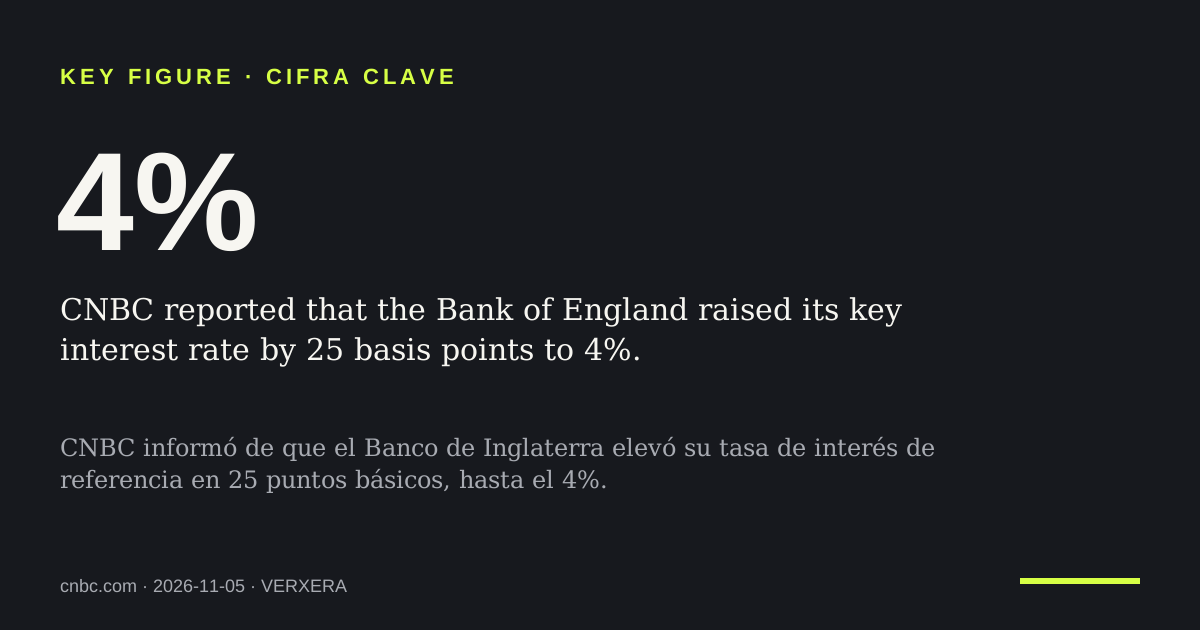
- CNBC reported that the Bank of England raised its key interest rate by 25 basis points to 4%.
- The BBC also reported that interest rates had risen to 4%.
- According to CNBC, the decision passed by eight votes to one. The dissenting member supported a larger, 50-basis-point increase to 4.25%.
- The BBC reported that the Bank’s forecasts indicated inflation was heading to just under 5% next spring, without specifying the year.
- CNBC reported that policymakers expected UK inflation to rise to about 5% by the middle of 2027.
- According to CNBC, the Monetary Policy Committee said the Middle East conflict was in its ninth month.
- CNBC reported that the committee said global energy prices had continued to rise from an already elevated level.
03
Analysis
The vote described by CNBC shows disagreement over the size of the increase, rather than a dissenting preference against an increase. The committee’s energy-price statement, also reported by CNBC, is policy context, not a measurement of the rate decision’s effects. The two inflation descriptions should remain distinct rather than be combined into a single precise forecast.
04 · VERXERA view
Editorial opinionVERXERA opinion: The clearest conclusion from CNBC and the BBC is a rate increase to 4% alongside an inflation outlook near 5%, not evidence of what the increase will achieve. CNBC’s 5 November 2026 report gives the move’s magnitude as 25 basis points; the BBC independently reports the resulting 4% rate. Connecting that agreement with their inflation reporting helps distinguish a policy decision from an expected outcome. The material limitation is precision: the BBC says just under 5% next spring without naming a year, while CNBC says about 5% by the middle of 2027. Neither wording should replace the other. Deeper source reading is worthwhile for readers who need the forecast’s exact timing, rather than the broad direction shared by the reports.
This is VERXERA’s editorial interpretation, separated from the facts and analysis above. The reader keeps the final judgment.
05
Counterevidence and limits
The BBC describes inflation heading to just under 5% next spring, while CNBC reports about 5% by the middle of 2027; the timing and numerical wording are not identical.
06
Known uncertainties
The BBC does not specify the year meant by next spring, leaving the precise relationship between its forecast timing and CNBC’s explicit middle-of-2027 timeframe unclear.
01
Lo que importa
Según las informaciones de CNBC y la BBC fechadas el 5 de noviembre de 2026, el Banco de Inglaterra elevó su tasa de interés al 4%. Ambos medios también recogieron perspectivas de inflación cercanas al 5%, con diferencias en la descripción del nivel y del calendario. La subida es el cambio de política comunicado; las cifras de inflación son previsiones, no resultados medidos.
02
Hechos verificados
- CNBC informó de que el Banco de Inglaterra elevó su tasa de interés de referencia en 25 puntos básicos, hasta el 4%.
- La BBC también informó de que los tipos de interés habían subido al 4%.
- Según CNBC, la decisión se aprobó por ocho votos contra uno. El miembro discrepante respaldó una subida mayor, de 50 puntos básicos, hasta el 4,25%.
- La BBC informó de que las previsiones del Banco apuntaban a una inflación ligeramente inferior al 5% la próxima primavera, sin especificar el año.
- CNBC informó de que los responsables de política monetaria esperaban que la inflación británica subiera hasta alrededor del 5% a mediados de 2027.
- Según CNBC, el Comité de Política Monetaria señaló que el conflicto en Oriente Medio estaba en su noveno mes.
- CNBC informó de que el comité señaló que los precios mundiales de la energía habían seguido aumentando desde un nivel ya elevado.
03
Análisis
La votación descrita por CNBC muestra un desacuerdo sobre la magnitud de la subida, no una preferencia del miembro discrepante por evitarla. La declaración del comité sobre la energía, también recogida por CNBC, constituye contexto de política monetaria, no una medición de los efectos de la decisión. Las dos descripciones de la inflación deben mantenerse diferenciadas, sin combinarlas en una única previsión precisa.
04 · Opinión VERXERA
Opinión editorialOpinión de VERXERA: La conclusión más clara de CNBC y la BBC es una subida de la tasa al 4% junto con perspectivas de inflación cercanas al 5%, no una prueba de lo que conseguirá esa subida. CNBC cifra el aumento en 25 puntos básicos en su información del 5 de noviembre de 2026; la BBC informa por separado de la tasa resultante del 4%. Relacionar esa coincidencia con sus previsiones de inflación permite distinguir una decisión de política monetaria de un resultado esperado. La limitación relevante es la precisión: la BBC habla de algo menos del 5% la próxima primavera sin indicar el año; CNBC, de alrededor del 5% a mediados de 2027. Ninguna formulación debe sustituir a la otra. Profundizar en las fuentes resulta útil para quien necesite precisar el calendario, más allá de la orientación general compartida.
Esta es la interpretación editorial de VERXERA, separada de los hechos y del análisis anteriores. El lector conserva la decisión final.
05
Contraste y límites
La BBC sitúa la inflación ligeramente por debajo del 5% la próxima primavera, mientras CNBC habla de alrededor del 5% a mediados de 2027; el calendario y la formulación numérica no son idénticos.
06
Incertidumbres conocidas
La BBC no especifica a qué año se refiere con la próxima primavera, por lo que no queda clara la relación exacta entre su calendario y el horizonte explícito de mediados de 2027 indicado por CNBC.