01
What matters
CBS News projected on November 9, 2026, that California voters rejected Proposition 40. The Guardian and BBC also reported its defeat. The proposed one-time 5% tax was presented by supporters as a response to healthcare cuts. Accounts differ on its taxable base, and revenue estimates diverge substantially.
02
Verified facts
- The Guardian reported on November 9, 2026, that California voters defeated Proposition 40, a proposed one-time tax on billionaires’ wealth.
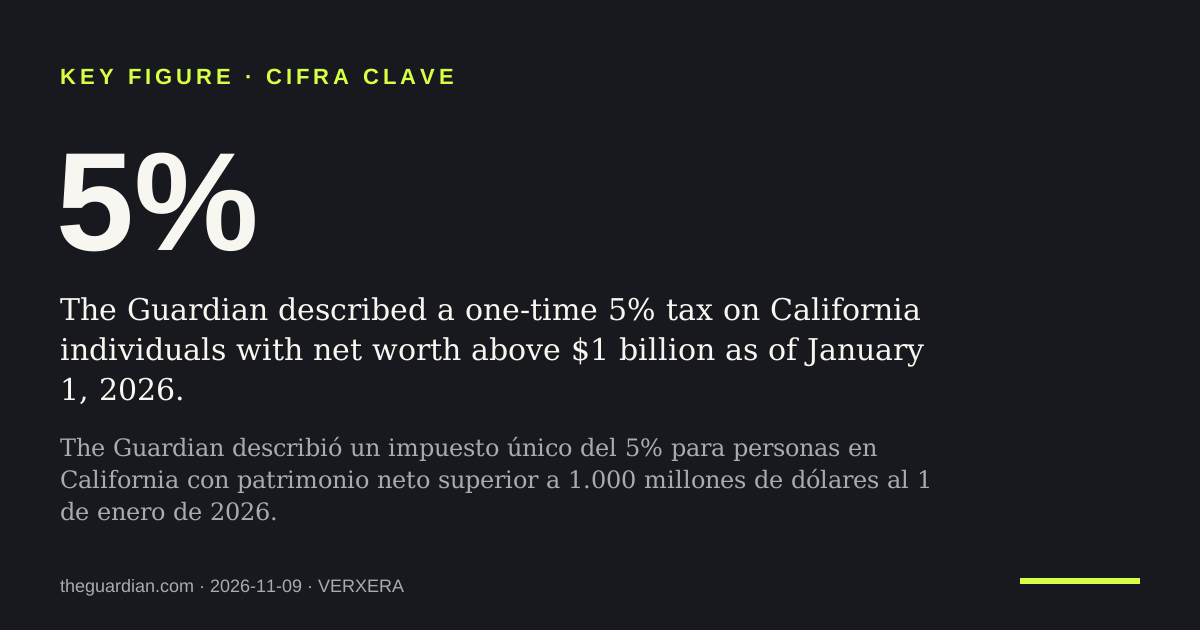
- The Guardian described a one-time 5% tax on California individuals with net worth above $1 billion as of January 1, 2026.
- The Guardian said supporters presented the measure as a response to healthcare cuts; proceeds would fund healthcare, education and food assistance.
- CBS News projected on November 9, 2026, that California voters rejected Proposition 40.
- CBS News described a one-time 5% tax on California residents with net worth of $1 billion, excluding real estate and certain retirement assets.
- CBS News attributed to proponents an expected $100 billion in revenue over five years.
- CBS News reported a Stanford study’s estimate that the measure might generate about $30 billion, rather than proponents’ $100 billion.
- The BBC reported rejection on November 10, 2026, saying nearly a week of post-election counting was needed to determine a projection.
- The BBC described a 5% tax on total wealth targeting Californians with wealth above $1.1 billion.
03
Analysis
The reports agree on rejection, with CBS explicitly calling it a projection. Supporters’ healthcare rationale describes an intended purpose, not a measured funding result. The competing revenue estimates address potential yield; they do not by themselves establish the broader case for or against wealth taxation or explain voters’ decisions.
04 · VERXERA view
Editorial opinionVERXERA opinion: The evidence supports reporting the projected rejection clearly while keeping the proposal’s ambitions separate from demonstrated outcomes. The Guardian’s account of supporters’ healthcare rationale connects with CBS News’s report of their expected $100 billion over five years: together, they explain the funding objective. CBS also reports a Stanford estimate of about $30 billion, a materially smaller potential yield, not money collected. That contrast matters when assessing what the proposed one-time 5% tax might have funded. The strongest limitation is that the accounts also disagree on eligibility and taxable assets, including thresholds above $1 billion and above $1.1 billion. Deeper source reading is worthwhile for assessing scope and revenue assumptions, not for treating this result as a general verdict on wealth taxation.
This is VERXERA’s editorial interpretation, separated from the facts and analysis above. The reader keeps the final judgment.
05
Counterevidence and limits
CBS News’s account of the Stanford estimate—about $30 billion versus proponents’ $100 billion—directly qualifies the funding ambition. The Guardian, CBS and BBC also describe materially different thresholds or asset coverage.
06
Known uncertainties
The exact eligibility threshold and taxable asset base remain unresolved across the accounts. A final certified vote tally and which arguments prevailed among voters remain unstated. This report reflects reporting as of November 10, 2026, at 04:22 UTC; later developments are not covered.
01
Lo que importa
CBS News proyectó el 9 de noviembre de 2026 que California rechazó la Proposición 40. The Guardian y la BBC también informaron de su derrota. Sus partidarios presentaban el impuesto único del 5% como respuesta a recortes sanitarios. Los relatos difieren sobre la base gravable y las estimaciones de recaudación divergen considerablemente.
02
Hechos verificados
- The Guardian informó el 9 de noviembre de 2026 que los votantes de California derrotaron la Proposición 40, un impuesto único propuesto sobre el patrimonio de los multimillonarios.
- The Guardian describió un impuesto único del 5% para personas en California con patrimonio neto superior a 1.000 millones de dólares al 1 de enero de 2026.
- The Guardian señaló que los partidarios presentaban la medida como respuesta a recortes sanitarios; la recaudación financiaría sanidad, educación y asistencia alimentaria.
- CBS News proyectó el 9 de noviembre de 2026 que los votantes de California rechazaron la Proposición 40.
- CBS News describió un impuesto único del 5% para residentes de California con patrimonio neto de 1.000 millones de dólares, excluidos los bienes inmuebles y ciertos activos de jubilación.
- CBS News atribuyó a los promotores una previsión de recaudación de 100.000 millones de dólares en cinco años.
- CBS News informó que un estudio de Stanford estimaba una posible recaudación de unos 30.000 millones de dólares, frente a los 100.000 millones previstos por los promotores.
- La BBC informó del rechazo el 10 de noviembre de 2026 y señaló que fue necesaria casi una semana de recuento postelectoral para determinar una proyección.
- La BBC describió un impuesto del 5% sobre el patrimonio total de californianos con más de 1.100 millones de dólares.
03
Análisis
Los medios coinciden en el rechazo; CBS lo presenta expresamente como una proyección. El argumento sanitario de los partidarios describe una finalidad, no un resultado medido. Las estimaciones contrapuestas evalúan la recaudación potencial; por sí solas no resuelven el debate sobre los impuestos patrimoniales ni explican las decisiones de los votantes.
04 · Opinión VERXERA
Opinión editorialOpinión de VERXERA: La evidencia respalda informar claramente del rechazo proyectado, separando las aspiraciones de la propuesta de sus resultados demostrados. El argumento sanitario recogido por The Guardian conecta con la previsión de los promotores comunicada por CBS News: 100.000 millones de dólares en cinco años. Juntos explican el objetivo financiero. CBS también recoge una estimación de Stanford de unos 30.000 millones: una recaudación potencial considerablemente menor, no dinero recaudado. El contraste importa para evaluar qué podría haber financiado el impuesto único del 5%. La principal limitación es que los relatos discrepan sobre requisitos y activos gravables, incluidos umbrales superiores a 1.000 millones y 1.100 millones de dólares. Profundizar en las fuentes resulta útil para evaluar alcance y supuestos recaudatorios, no para interpretar el resultado como un veredicto general sobre los impuestos patrimoniales.
Esta es la interpretación editorial de VERXERA, separada de los hechos y del análisis anteriores. El lector conserva la decisión final.
05
Contraste y límites
La estimación de Stanford recogida por CBS News —unos 30.000 millones de dólares frente a los 100.000 millones de los promotores— matiza directamente la ambición financiera. The Guardian, CBS y la BBC también describen diferencias materiales en umbrales o activos gravables.
06
Incertidumbres conocidas
Siguen sin resolverse el umbral exacto y la base gravable. No se indica un recuento final certificado ni qué argumentos prevalecieron entre los votantes. Este informe refleja las informaciones hasta el 10 de noviembre de 2026 a las 04:22 UTC; no abarca acontecimientos posteriores.