01
What matters
CNBC and PBS reported 165,000 additional U.S. jobs in October 2026 and upward adjustments to August and September employment gains. Their reporting points to stronger payroll growth, while CNBC’s broader labor-market measure offers a less favorable signal. PBS placed the figures alongside questions about the sustainability of the AI boom.
02
Verified facts
- CNBC reported that seasonally adjusted U.S. nonfarm payrolls increased by 165,000 jobs in October 2026, compared with a Dow Jones estimate of 59,000.
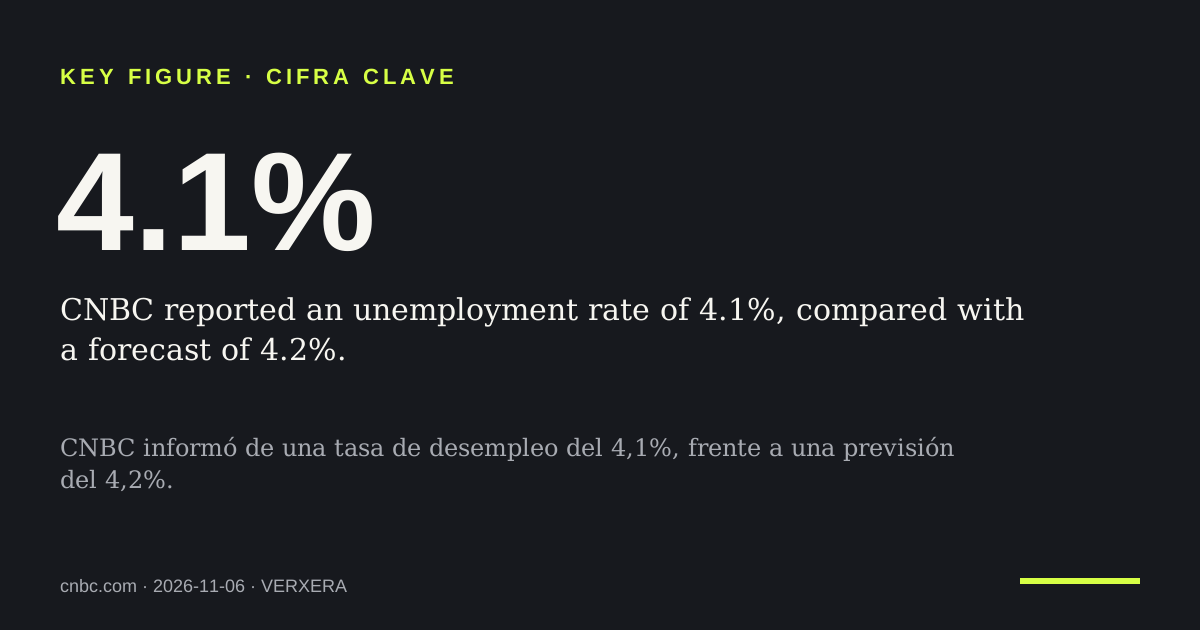
- CNBC reported an unemployment rate of 4.1%, compared with a forecast of 4.2%.
- According to CNBC, August payroll growth was revised upward by 53,000 jobs to 186,000, and September’s gain was revised upward by 31,000 to 60,000.
- CNBC reported that the broader measure including discouraged workers and people working part-time for economic reasons rose to 7.9%, an increase of 0.3 percentage point.
- PBS reported that employers added 165,000 jobs in October and that August and September employment gains were revised upward by a combined 84,000 jobs.
- PBS framed the employment figures alongside growing questions about the sustainability of the AI boom. That framing was not a finding that the boom was unsustainable.
03
Analysis
Bounded analysis: CNBC and PBS agree on October’s payroll gain and the upward direction of the preceding months’ adjustments. CNBC’s individual adjustments and PBS’s combined figure describe the same total increase. The distinction between CNBC’s unemployment rate and its broader measure matters: the latter explicitly includes discouraged workers and people working part-time for economic reasons. These reported measures therefore should not be treated as interchangeable.
04 · VERXERA view
Editorial opinionVERXERA opinion: The evidence-led conclusion is stronger payroll growth, not an all-clear on labor-market conditions or AI. CNBC and PBS both report 165,000 additional jobs in October 2026; CNBC’s 59,000-job forecast comparison and PBS’s combined 84,000-job upward adjustment for August and September put that strength in perspective. At the same time, CNBC reports unemployment at 4.1% and a broader measure rising 0.3 percentage point to 7.9%, a material qualification to the favorable headline. The outlets’ emphasis differs: CNBC supplies forecast comparisons, while PBS frames the figures alongside questions about AI’s sustainability. That connection matters because employment strength does not settle the separate AI question. Deeper source reading is worthwhile for understanding those distinct measures and framing, rather than seeking a single verdict on the economy.
This is VERXERA’s editorial interpretation, separated from the facts and analysis above. The reader keeps the final judgment.
05
Counterevidence and limits
CNBC’s reported rise in the broader labor-market measure to 7.9% qualifies the favorable payroll figures without contradicting them.
06
Known uncertainties
Whether the AI boom is sustainable remains an open question in PBS’s framing; the reported payroll figures do not resolve it.
01
Lo que importa
CNBC y PBS informaron de 165.000 empleos adicionales en Estados Unidos en octubre de 2026 y de ajustes al alza en los aumentos de agosto y septiembre. Sus informaciones apuntan a un crecimiento más sólido del empleo, mientras que el indicador laboral más amplio de CNBC ofrece una señal menos favorable. PBS situó las cifras junto a interrogantes sobre la sostenibilidad del auge de la IA.
02
Hechos verificados
- CNBC informó de que las nóminas no agrícolas estadounidenses, ajustadas por estacionalidad, aumentaron en 165.000 puestos en octubre de 2026, frente a una estimación de Dow Jones de 59.000.
- CNBC informó de una tasa de desempleo del 4,1%, frente a una previsión del 4,2%.
- Según CNBC, el aumento del empleo de agosto se revisó al alza en 53.000 puestos, hasta 186.000, y el de septiembre se revisó al alza en 31.000, hasta 60.000.
- CNBC informó de que el indicador más amplio, que incluye a trabajadores desanimados y a personas que trabajan a tiempo parcial por razones económicas, subió al 7,9%, un incremento de 0,3 puntos porcentuales.
- PBS informó de que los empleadores añadieron 165.000 puestos en octubre y de que los aumentos de agosto y septiembre se revisaron al alza en un total de 84.000 empleos.
- PBS presentó las cifras de empleo junto a crecientes interrogantes sobre la sostenibilidad del auge de la IA. Ese enfoque no constituyó una conclusión de que el auge fuera insostenible.
03
Análisis
Análisis acotado: CNBC y PBS coinciden en el aumento del empleo de octubre y en la dirección alcista de los ajustes de los meses anteriores. Los ajustes individuales de CNBC y la cifra conjunta de PBS describen el mismo incremento total. Importa distinguir entre la tasa de desempleo y el indicador más amplio que recoge CNBC: este último incluye expresamente a trabajadores desanimados y a personas que trabajan a tiempo parcial por razones económicas. Por tanto, estos indicadores no deben tratarse como intercambiables.
04 · Opinión VERXERA
Opinión editorialOpinión de VERXERA: La conclusión respaldada por las cifras es un crecimiento más sólido del empleo, no una señal de que todo marche bien en el mercado laboral o la IA. CNBC y PBS informan de 165.000 puestos adicionales en octubre de 2026; la previsión de 59.000 citada por CNBC y el ajuste conjunto al alza de 84.000 para agosto y septiembre señalado por PBS dimensionan esa fortaleza. A la vez, CNBC sitúa el desempleo en el 4,1% y el indicador más amplio en el 7,9%, tras subir 0,3 puntos porcentuales: un matiz importante. El énfasis difiere: CNBC ofrece comparaciones con previsiones; PBS incorpora interrogantes sobre la sostenibilidad de la IA. La fortaleza del empleo no resuelve esa cuestión separada. Profundizar en ambas informaciones permite entender indicadores y enfoques distintos, no obtener un veredicto único sobre la economía.
Esta es la interpretación editorial de VERXERA, separada de los hechos y del análisis anteriores. El lector conserva la decisión final.
05
Contraste y límites
La subida al 7,9% del indicador laboral más amplio que recoge CNBC matiza las cifras favorables de empleo sin contradecirlas.
06
Incertidumbres conocidas
La sostenibilidad del auge de la IA sigue siendo una cuestión abierta en el enfoque de PBS; las cifras de empleo citadas no la resuelven.