In this article
- NVDANVIDIA · NASDAQ$178.67▼ 4.27% day
Prices from Twelve Data, captured Nov 9, 5:38 PM ET; not updated after publication. Day change is against the prior close. Not investment advice.
01
What matters
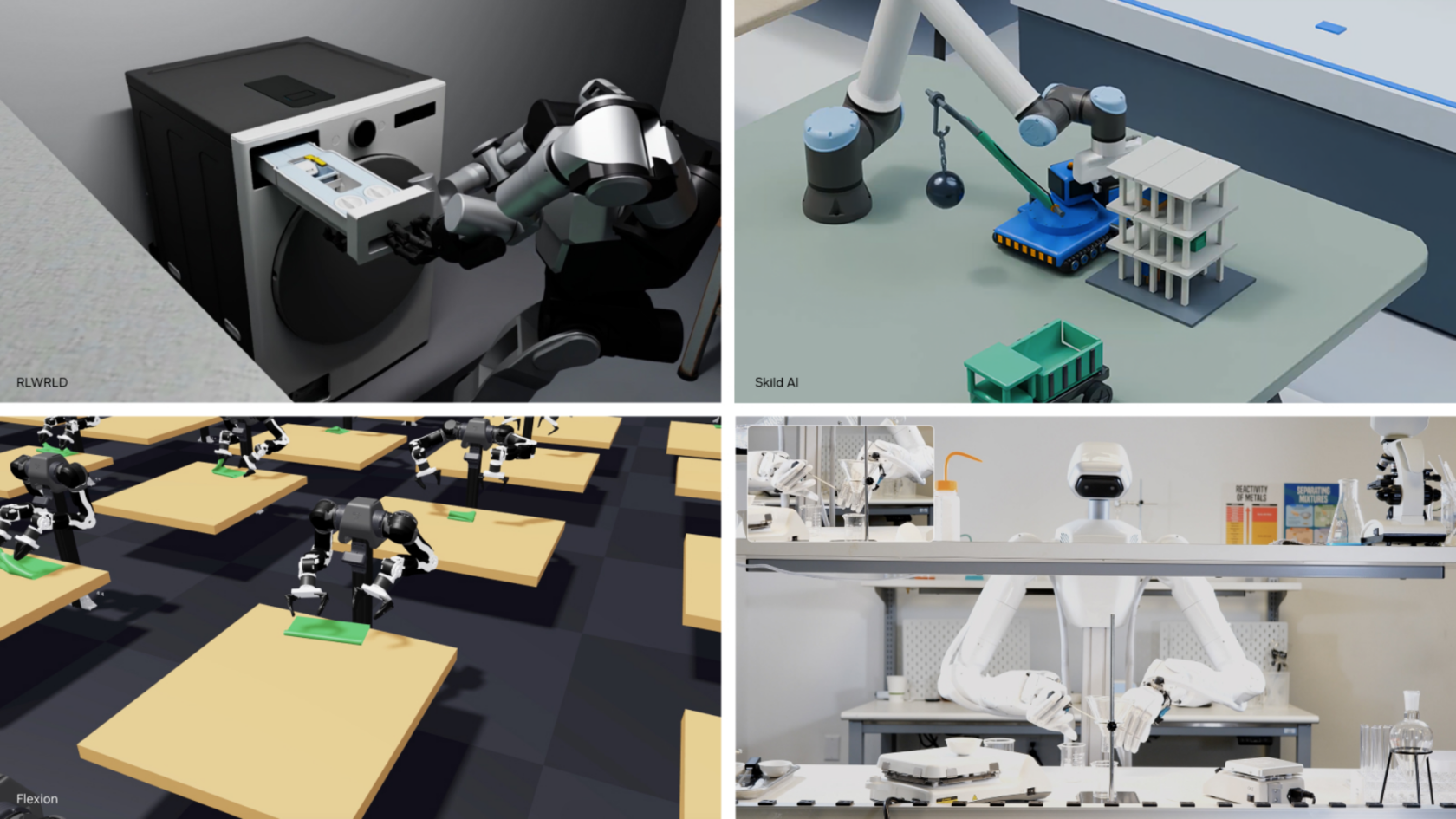
In its November 9, 2026 announcement, NVIDIA introduced GR00T 2, Isaac Lab 3.0 and open benchmarks at the Conference on Robot Learning. The company reported robot-task performance results and a simulation-training throughput comparison, alongside a choice of physics solvers for researchers.
02
Verified facts
- NVIDIA said it was introducing GR00T 2, Isaac Lab 3.0 and open benchmarks at the Conference on Robot Learning, known as CoRL.
- NVIDIA reported that GR00T 2 completed 40 of 50 evaluated tasks at least once without task-specific demonstrations. That measure records whether a task was completed at least once, rather than a repeated-success rate.
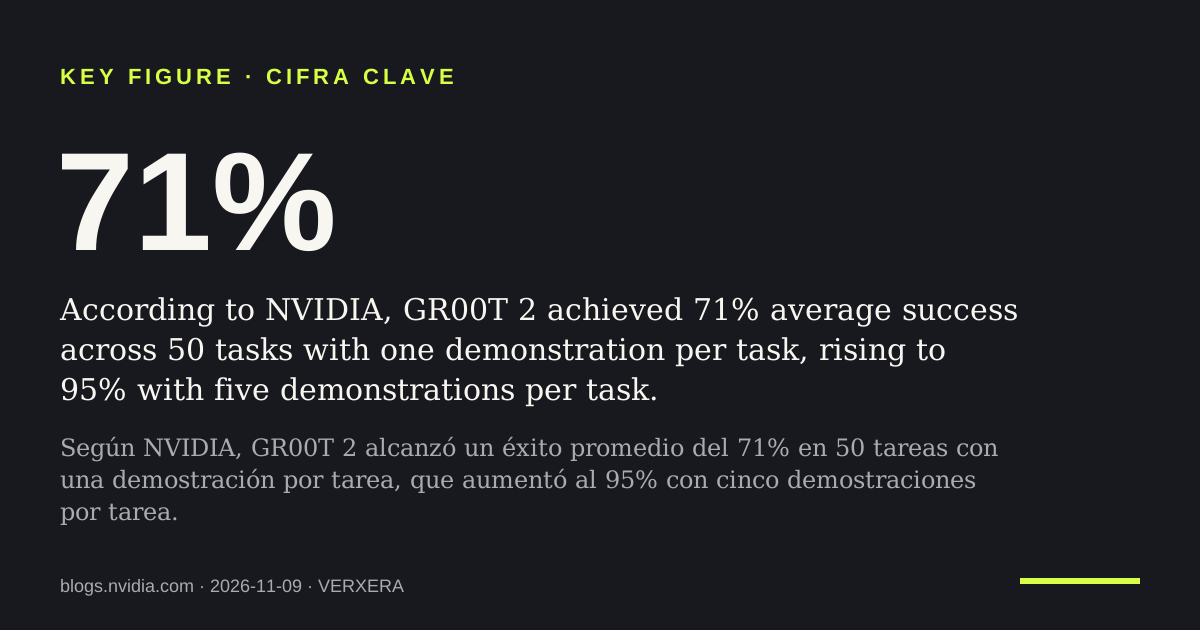
- According to NVIDIA, GR00T 2 achieved 71% average success across 50 tasks with one demonstration per task, rising to 95% with five demonstrations per task.
- NVIDIA reported that Isaac Lab 3.0 with Newton achieved up to 2.5 times the training throughput of Isaac Lab 2.3 with PhysX in a vision-based dexterous manipulation benchmark.
- NVIDIA said Isaac Lab 3.0 allows researchers to switch between the NVIDIA PhysX and Newton physics solvers.
03
Analysis
The reported measures answer different questions: task completion without demonstrations, average success with demonstrations, and simulation-training throughput. They should not be treated as interchangeable measures of robot reliability. The throughput comparison also changes both the Isaac Lab version and the physics solver; it does not isolate either change’s contribution. Its stated scope is one vision-based dexterous manipulation benchmark, not every training workload.
04 · VERXERA view
Editorial opinionVERXERA opinion: NVIDIA’s November 9, 2026 announcement offers a concrete basis for examining robot learning and simulation together, rather than treating either as a complete performance verdict. The company reports 71% average success across 50 tasks with one demonstration per task and 95% with five, alongside up to 2.5 times the training throughput for Isaac Lab 3.0 with Newton versus Isaac Lab 2.3 with PhysX. That connection matters because task success and training throughput describe distinct dimensions of the announced tools. The separate result of completing 40 of 50 tasks at least once without task-specific demonstrations must retain its narrower meaning. These company-reported results do not establish consistent performance across other tasks or workloads. Deeper source reading is worthwhile for readers whose work matches those evaluation settings, not as a general guarantee of robot capability.
This is VERXERA’s editorial interpretation, separated from the facts and analysis above. The reader keeps the final judgment.
05
Counterevidence and limits
This report rests on NVIDIA’s announcement; the performance figures and product descriptions are the company’s statements.
06
Known uncertainties
How consistently GR00T 2 repeats the tasks completed at least once, and how broadly the reported throughput advantage applies beyond the named benchmark, remain open questions.
En este artículo
- NVDANVIDIA · NASDAQ$178.67▼ 4.27% día
Precios de Twelve Data capturados el 9 nov, 5:38 p.m. ET; no se actualizan después de publicar. El cambio del día se compara con el cierre anterior. No es asesoría de inversión.
01
Lo que importa
En su anuncio del 9 de noviembre de 2026, NVIDIA presentó GR00T 2, Isaac Lab 3.0 y pruebas de referencia abiertas en la Conferencia sobre Aprendizaje Robótico. La empresa comunicó resultados de tareas robóticas y una comparación del rendimiento de entrenamiento en simulación, además de una opción de motores de física para investigadores.
02
Hechos verificados
- NVIDIA afirmó que estaba presentando GR00T 2, Isaac Lab 3.0 y pruebas de referencia abiertas en la Conferencia sobre Aprendizaje Robótico, conocida como CoRL.
- NVIDIA informó que GR00T 2 completó al menos una vez 40 de las 50 tareas evaluadas sin demostraciones específicas para cada tarea. Esa medida registra si una tarea se completó al menos una vez, no una tasa de éxito repetido.
- Según NVIDIA, GR00T 2 alcanzó un éxito promedio del 71% en 50 tareas con una demostración por tarea, que aumentó al 95% con cinco demostraciones por tarea.
- NVIDIA informó que Isaac Lab 3.0 con Newton alcanzó hasta 2,5 veces el rendimiento de entrenamiento de Isaac Lab 2.3 con PhysX en una prueba de manipulación diestra basada en visión.
- NVIDIA afirmó que Isaac Lab 3.0 permite a los investigadores alternar entre los motores de física NVIDIA PhysX y Newton.
03
Análisis
Las medidas comunicadas responden a preguntas distintas: completar tareas sin demostraciones, lograr un éxito promedio con demostraciones y alcanzar cierto rendimiento de entrenamiento en simulación. No deben tratarse como medidas intercambiables de fiabilidad robótica. La comparación de rendimiento también cambia tanto la versión de Isaac Lab como el motor de física; no aísla la contribución de cada cambio. Su alcance declarado es una prueba de manipulación diestra basada en visión, no todas las cargas de entrenamiento.
04 · Opinión VERXERA
Opinión editorialOpinión de VERXERA: El anuncio de NVIDIA del 9 de noviembre de 2026 ofrece una base concreta para examinar conjuntamente aprendizaje robótico y simulación, sin convertir ninguno en un veredicto completo sobre rendimiento. La empresa comunica un éxito promedio del 71% en 50 tareas con una demostración por tarea y del 95% con cinco, junto con hasta 2,5 veces el rendimiento de entrenamiento de Isaac Lab 3.0 con Newton frente a Isaac Lab 2.3 con PhysX. La conexión importa porque el éxito y el rendimiento de entrenamiento describen dimensiones distintas. Completar 40 de 50 tareas al menos una vez sin demostraciones específicas conserva un significado más limitado. Estos resultados empresariales no establecen un desempeño consistente en otras tareas o cargas. Profundizar en la fuente resulta pertinente para quienes trabajan en condiciones similares, no como garantía general de capacidad robótica.
Esta es la interpretación editorial de VERXERA, separada de los hechos y del análisis anteriores. El lector conserva la decisión final.
05
Contraste y límites
Este informe se basa en el anuncio de NVIDIA; las cifras de rendimiento y las descripciones de los productos son afirmaciones de la empresa.
06
Incertidumbres conocidas
Siguen abiertas las preguntas sobre la constancia con que GR00T 2 repite las tareas completadas al menos una vez y sobre el alcance de la ventaja de rendimiento fuera de la prueba mencionada.