01
What matters
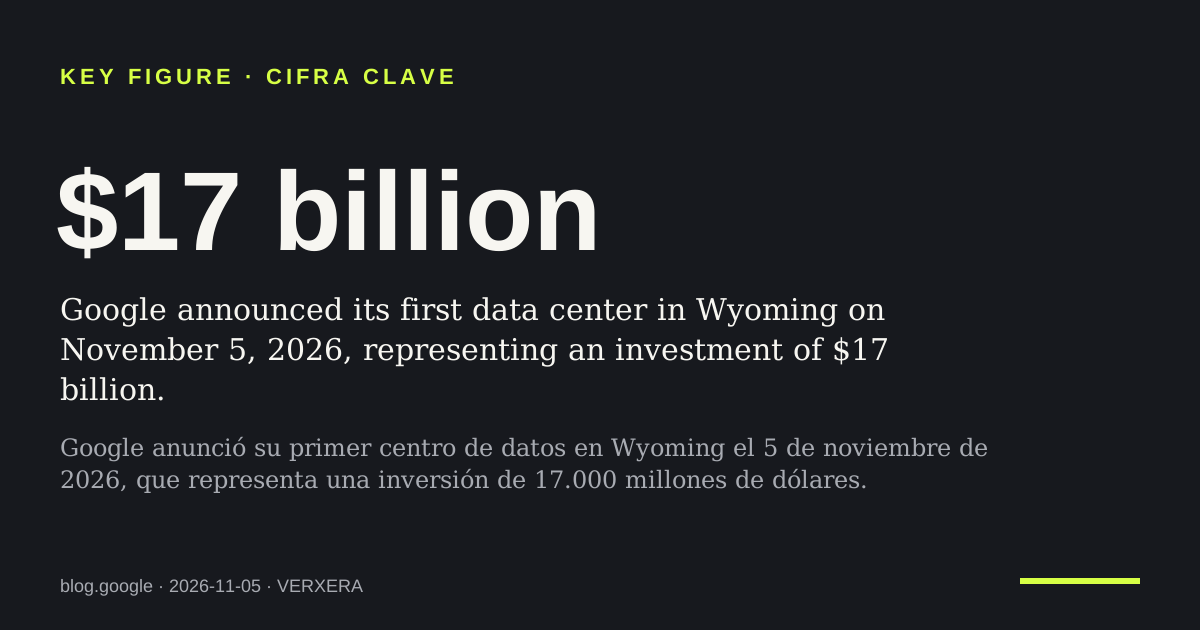
Google announced its first Wyoming data center on November 5, 2026, describing a $17 billion investment. Its announcement combines an energy-development plan, air cooling and commitments on power costs with an expectation of local property-tax revenue. These are company plans and expectations, not reported operating results.
02
Verified facts
- Google announced its first data center in Wyoming on November 5, 2026, representing an investment of $17 billion.
- Google said its partners on the project are Tallgrass Energy, Black Hills Energy, American Electric Power (AEP) and Related Digital.
- According to Google, the project is contracted with AEP to include a commercial-scale, 702-megawatt (MW) fuel-cell development with carbon capture and storage.
- Google said the Wyoming data center will use air cooling, with the stated aim of minimizing strain on local water resources.
- Google expects the project to generate hundreds of millions of dollars in local property taxes for Laramie County and School District 1.
- Google said it will pay for 100% of the power it uses and cover infrastructure needs directly driven by its growth.
03
Analysis
The announcement brings together distinct measures: an investment amount, planned electricity-generation capacity and expected tax revenue. They are not interchangeable indicators of completed development or public benefit. The 702 MW figure describes the contracted fuel-cell development, not measured electricity consumption at the data center. Likewise, the air-cooling plan states an intended water-resource benefit rather than a quantified reduction in water use.
04 · VERXERA view
Editorial opinionVERXERA opinion: Google's November 5, 2026 announcement is significant as a defined investment and infrastructure plan, rather than evidence of benefits already delivered. The $17 billion investment and contracted 702 MW fuel-cell development establish the announced financial and energy scale; the expectation of hundreds of millions of dollars in local property taxes identifies a separate potential public benefit. Connecting those commitments matters because investment spending, generating capacity and tax receipts describe different aspects of the project, not equivalent outcomes. Google's commitment to pay for 100% of its power use adds an important cost-responsibility statement. The strongest limitation is that these commitments and expectations do not establish operating performance or realized revenue. Deeper source reading is worthwhile for understanding those commitments, not for treating projections as results.
This is VERXERA’s editorial interpretation, separated from the facts and analysis above. The reader keeps the final judgment.
05
Counterevidence and limits
This report rests on Google's announcement; the investment, technical plans, cost commitments and tax expectations are the company's statements.
06
Known uncertainties
The announcement does not specify an opening date, an investment-disbursement schedule or the period over which the expected property taxes would accrue.
01
Lo que importa
Google anunció su primer centro de datos en Wyoming el 5 de noviembre de 2026, con una inversión de 17.000 millones de dólares. El anuncio combina un plan de desarrollo energético, refrigeración por aire y compromisos sobre costos eléctricos con una expectativa de ingresos tributarios locales. Son planes y previsiones de la empresa, no resultados operativos.
02
Hechos verificados
- Google anunció su primer centro de datos en Wyoming el 5 de noviembre de 2026, que representa una inversión de 17.000 millones de dólares.
- Google indicó que sus socios en el proyecto son Tallgrass Energy, Black Hills Energy, American Electric Power (AEP) y Related Digital.
- Según Google, el proyecto tiene un contrato con AEP para incorporar una instalación de pilas de combustible a escala comercial de 702 megavatios (MW), con captura y almacenamiento de carbono.
- Google señaló que el centro de datos de Wyoming utilizará refrigeración por aire, con el objetivo declarado de minimizar la presión sobre los recursos hídricos locales.
- Google prevé que el proyecto genere cientos de millones de dólares en impuestos locales sobre la propiedad para el condado de Laramie y el Distrito Escolar 1.
- Google afirmó que pagará el 100% de la electricidad que utilice y cubrirá las necesidades de infraestructura directamente derivadas de su crecimiento.
03
Análisis
El anuncio reúne medidas distintas: un monto de inversión, capacidad prevista de generación eléctrica e ingresos tributarios esperados. No son indicadores intercambiables de desarrollo completado o beneficio público. Los 702 MW describen la instalación de pilas de combustible contratada, no el consumo eléctrico medido del centro de datos. Asimismo, la refrigeración por aire expresa un beneficio hídrico buscado, no una reducción cuantificada del consumo de agua.
04 · Opinión VERXERA
Opinión editorialOpinión de VERXERA: El anuncio de Google del 5 de noviembre de 2026 importa como plan definido de inversión e infraestructura, no como prueba de beneficios realizados. Los 17.000 millones de dólares y la instalación contratada de 702 MW establecen la escala financiera y energética anunciada; la expectativa de cientos de millones de dólares en impuestos locales señala un beneficio público potencial distinto. Relacionarlos importa porque inversión, capacidad generadora y recaudación describen aspectos diferentes, no resultados equivalentes. El compromiso de pagar el 100% de su electricidad añade una declaración relevante sobre responsabilidad por los costos. La principal limitación es que estos compromisos y expectativas no demuestran desempeño operativo ni ingresos realizados. Profundizar en la fuente sirve para entender los compromisos, no para tratar proyecciones como resultados.
Esta es la interpretación editorial de VERXERA, separada de los hechos y del análisis anteriores. El lector conserva la decisión final.
05
Contraste y límites
Este informe se basa en el anuncio de Google; la inversión, los planes técnicos, los compromisos de costos y las expectativas tributarias son declaraciones de la empresa.
06
Incertidumbres conocidas
El anuncio no especifica una fecha de apertura, un calendario de desembolso de la inversión ni el período durante el cual se acumularían los impuestos sobre la propiedad previstos.