01
What matters
U.S. household debt rose to $19.1 trillion in Q3 2026, according to the Federal Reserve Bank of New York, while PYMNTS reported falling debt confidence among paycheck-to-paycheck consumers keeping up with bills. The figures distinguish outstanding borrowing from consumers’ expectations about managing it.
02
Verified facts
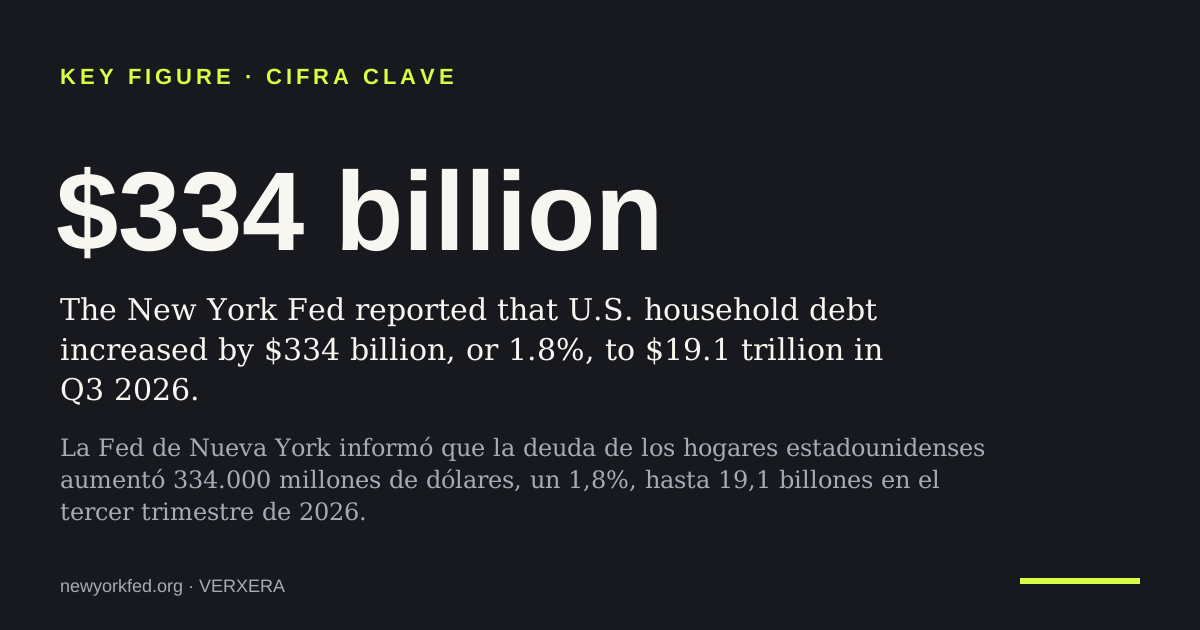
- The New York Fed reported that U.S. household debt increased by $334 billion, or 1.8%, to $19.1 trillion in Q3 2026.
- The New York Fed said 5.0% of outstanding household debt was in some stage of delinquency at the end of September 2026, up 0.3 percentage points from the previous quarter.
- Mortgage balances rose $257 billion in Q3 2026 to $13.4 trillion at September’s end, according to the New York Fed. It said about half the increase reflected balances returning after a previous-quarter reporting gap.
- PYMNTS alone reported that 61.1% of paycheck-to-paycheck consumers paying bills without difficulty were confident in October about managing existing debt over the next 12 months, down from 71.2% in September.
- PYMNTS alone reported that confidence among paycheck-to-paycheck consumers struggling with bills rose two percentage points to 42.8%. That remained the lowest confidence level among the three groups surveyed.
- PYMNTS said its survey covered 2,087 U.S. consumers, was conducted October 1–13, 2026, and asked about expectations for managing debts already owed.
03
Analysis
The New York Fed’s figures describe debt balances and delinquency through September; PYMNTS’ October survey describes expectations. These measures address different questions and do not establish that rising debt caused confidence to fall. The mortgage reporting gap also means the full reported increase cannot be read as new borrowing. PYMNTS’ confidence results moved in different directions across the two paycheck-to-paycheck groups.
04 · VERXERA view
Editorial opinionVERXERA opinion: The evidence supports concern about debt management, not a uniform deterioration across households. The New York Fed’s $19.1 trillion debt total for Q3 2026 and 5.0% delinquency share at September’s end provide a balance-sheet perspective. PYMNTS’ decline from 71.2% in September to 61.1% in October among paycheck-to-paycheck consumers keeping up with bills adds a distinct signal about expectations. Their connection matters because payment status and confidence are not interchangeable measures. The limits are material: about half the $257 billion mortgage increase reflected a reporting gap, while confidence among consumers struggling with bills rose two percentage points to 42.8%. Deeper source reading is worthwhile for understanding those distinctions, rather than treating the headline total as evidence of every household’s condition.
This is VERXERA’s editorial interpretation, separated from the facts and analysis above. The reader keeps the final judgment.
05
Counterevidence and limits
PYMNTS reported improving confidence among consumers struggling with bills, while the New York Fed attributed about half the mortgage increase to balances returning after a reporting gap.
06
Known uncertainties
The New York Fed report identifies Q3 2026 without stating its publication date. The figures do not establish whether October’s confidence changes persisted. This report reflects the sources as of November 11, 2026; that cutoff is separate from the observation periods, and later developments are not covered.
01
Lo que importa
La deuda de los hogares estadounidenses subió a 19,1 billones de dólares en el tercer trimestre de 2026, según el Banco de la Reserva Federal de Nueva York, mientras PYMNTS informó de una menor confianza entre quienes viven al día y cumplen con sus pagos. Las cifras distinguen la deuda pendiente de las expectativas sobre cómo gestionarla.
02
Hechos verificados
- La Fed de Nueva York informó que la deuda de los hogares estadounidenses aumentó 334.000 millones de dólares, un 1,8%, hasta 19,1 billones en el tercer trimestre de 2026.
- La Fed de Nueva York indicó que el 5,0% de la deuda pendiente de los hogares presentaba algún grado de morosidad al cierre de septiembre de 2026, un aumento de 0,3 puntos porcentuales frente al trimestre anterior.
- Los saldos hipotecarios aumentaron 257.000 millones de dólares en el tercer trimestre de 2026 hasta 13,4 billones al cierre de septiembre, según la Fed de Nueva York. La entidad atribuyó aproximadamente la mitad del incremento a saldos reincorporados tras una interrupción en los reportes del trimestre anterior.
- Únicamente PYMNTS informó que, entre los consumidores que viven al día y pagan sus cuentas sin dificultad, el 61,1% confiaba en octubre en gestionar su deuda existente durante los siguientes 12 meses, frente al 71,2% en septiembre.
- Únicamente PYMNTS informó que la confianza entre quienes viven al día y tienen dificultades para pagar sus cuentas subió dos puntos porcentuales, hasta el 42,8%. Siguió siendo el nivel más bajo de los tres grupos encuestados.
- PYMNTS indicó que su encuesta abarcó a 2.087 consumidores estadounidenses, se realizó del 1 al 13 de octubre de 2026 y preguntó por sus expectativas para gestionar deudas ya contraídas.
03
Análisis
Las cifras de la Fed de Nueva York describen saldos y morosidad hasta septiembre; la encuesta de octubre de PYMNTS describe expectativas. Son medidas distintas y no establecen que el aumento de la deuda causara la caída de la confianza. La interrupción en los reportes hipotecarios también impide interpretar todo el incremento como nuevo endeudamiento. La confianza evolucionó en direcciones distintas entre los dos grupos que viven al día.
04 · Opinión VERXERA
Opinión editorialOpinión de VERXERA: La evidencia justifica preocupación por la gestión de la deuda, no una lectura de deterioro uniforme. Los 19,1 billones de dólares de deuda en el tercer trimestre de 2026 y el 5,0% en morosidad al cierre de septiembre, según la Fed de Nueva York, describen saldos y pagos. La caída del 71,2% en septiembre al 61,1% en octubre que PYMNTS registró entre quienes viven al día y cumplen sus pagos aporta una señal sobre expectativas. La conexión importa porque cumplimiento y confianza no son equivalentes. Los límites son sustanciales: aproximadamente la mitad del aumento hipotecario de 257.000 millones respondió a una interrupción de reportes, y la confianza entre quienes tenían dificultades subió dos puntos porcentuales, al 42,8%. Profundizar en las fuentes sirve para entender esas diferencias, no para atribuir a cada hogar la situación del total.
Esta es la interpretación editorial de VERXERA, separada de los hechos y del análisis anteriores. El lector conserva la decisión final.
05
Contraste y límites
PYMNTS informó de una mejora de la confianza entre quienes tenían dificultades para pagar, mientras la Fed de Nueva York atribuyó aproximadamente la mitad del aumento hipotecario a saldos reincorporados tras una interrupción en los reportes.
06
Incertidumbres conocidas
El informe de la Fed de Nueva York identifica el tercer trimestre de 2026 sin indicar su fecha de publicación. Las cifras no establecen si los cambios de confianza de octubre persistieron. Este informe refleja las fuentes al 11 de noviembre de 2026; esa fecha de corte es distinta de los períodos observados y no se incluyen acontecimientos posteriores.