01
What matters
Robot programs completed 221 of 240 physical evaluation trials without a human or coding agent in the execution loop, according to CryptoSlate. The reported result distinguishes execution without that involvement from development, when human guidance and demonstrations were available.
02
Verified facts
- CryptoSlate published its report on November 15, 2026, at 2:40 pm GMT.
- According to CryptoSlate, the ACE-CaP-0 study was posted November 12.
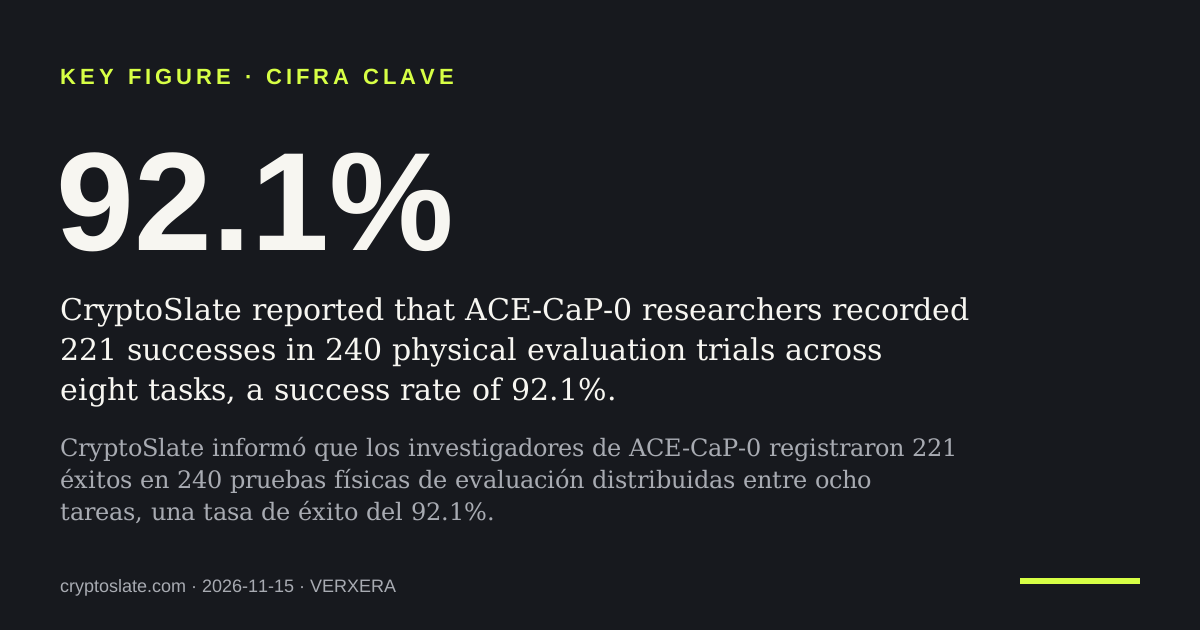
- CryptoSlate reported that ACE-CaP-0 researchers recorded 221 successes in 240 physical evaluation trials across eight tasks, a success rate of 92.1%.
- According to CryptoSlate, each task program was frozen—kept unchanged—before 30 separate evaluation trials, with no further updates.
- CryptoSlate reported that human guidance and demonstrations were available during program development.
- During evaluation, neither a human nor the coding agent was in the execution loop, according to CryptoSlate.
- CryptoSlate cautioned that repeated execution on the tested tasks does not establish that the programs can be reused under new conditions.
03
Analysis
The evaluation described by CryptoSlate concerns repeated execution of eight unchanged task programs, with 30 trials for each. It separates two stages: development with human assistance available, and evaluation without a human or coding agent in the execution loop. The reported 92.1% therefore describes performance across those physical trials, not demonstrated reuse under new conditions.
04 · VERXERA view
Editorial opinionVERXERA opinion: The evidence supports a narrow, meaningful conclusion: repeated execution without a human or coding agent in the loop is distinct from development without human help. In the study posted November 12 and reported by CryptoSlate on November 15, 2026, the programs succeeded in 221 of 240 physical trials, or 92.1%, across eight tasks. Keeping each program unchanged for 30 trials connects that result to repeated execution rather than continuing program updates. Human guidance and demonstrations remained available during development, so the result should not be read as an entirely unassisted process. This account rests on CryptoSlate’s report alone, and reuse under new conditions remains unestablished. Deeper source reading is worthwhile for readers assessing that specific boundary between assisted development and execution.
This is VERXERA’s editorial interpretation, separated from the facts and analysis above. The reader keeps the final judgment.
05
Counterevidence and limits
CryptoSlate explicitly limits the finding: repeated execution on tested tasks does not establish reuse under new conditions.
06
Known uncertainties
Whether these task programs can be reused under new conditions remains unresolved in CryptoSlate’s account.
01
Lo que importa
Los programas robóticos completaron con éxito 221 de 240 pruebas físicas de evaluación sin una persona ni un agente de programación en el ciclo de ejecución, según CryptoSlate. El resultado distingue esa ejecución del desarrollo, durante el cual había orientación humana y demostraciones disponibles.
02
Hechos verificados
- CryptoSlate publicó su informe el 15 de noviembre de 2026 a las 2:40 pm GMT.
- Según CryptoSlate, el estudio ACE-CaP-0 se publicó el 12 de noviembre.
- CryptoSlate informó que los investigadores de ACE-CaP-0 registraron 221 éxitos en 240 pruebas físicas de evaluación distribuidas entre ocho tareas, una tasa de éxito del 92.1%.
- Según CryptoSlate, cada programa de tarea quedó congelado —sin cambios— antes de 30 pruebas de evaluación separadas, sin actualizaciones posteriores.
- CryptoSlate informó que durante el desarrollo de los programas había orientación humana y demostraciones disponibles.
- Durante la evaluación, ni una persona ni el agente de programación participaron en el ciclo de ejecución, según CryptoSlate.
- CryptoSlate advirtió que la ejecución repetida de las tareas evaluadas no demuestra que los programas puedan reutilizarse en condiciones nuevas.
03
Análisis
La evaluación descrita por CryptoSlate corresponde a la ejecución repetida de ocho programas de tareas sin cambios, con 30 pruebas para cada uno. Separa dos etapas: el desarrollo con asistencia humana disponible y la evaluación sin una persona ni un agente de programación en el ciclo de ejecución. Por tanto, el 92.1% informado describe el desempeño en esas pruebas físicas, no una reutilización demostrada en condiciones nuevas.
04 · Opinión VERXERA
Opinión editorialOpinión de VERXERA: La evidencia respalda una conclusión acotada y significativa: ejecutar repetidamente sin una persona ni un agente de programación en el ciclo es distinto de desarrollar sin ayuda humana. En el estudio publicado el 12 de noviembre y reseñado por CryptoSlate el 15 de noviembre de 2026, los programas tuvieron éxito en 221 de 240 pruebas físicas, el 92.1%, en ocho tareas. Mantener cada programa sin cambios durante 30 pruebas vincula el resultado con la ejecución repetida, no con actualizaciones continuas. La orientación humana y las demostraciones estaban disponibles durante el desarrollo; no fue un proceso enteramente sin asistencia. Esta exposición depende únicamente del informe de CryptoSlate, y la reutilización en condiciones nuevas sigue sin demostrarse. Profundizar en la fuente resulta pertinente para evaluar ese límite entre desarrollo asistido y ejecución.
Esta es la interpretación editorial de VERXERA, separada de los hechos y del análisis anteriores. El lector conserva la decisión final.
05
Contraste y límites
CryptoSlate limita expresamente el hallazgo: ejecutar repetidamente las tareas evaluadas no demuestra la reutilización en condiciones nuevas.
06
Incertidumbres conocidas
La posibilidad de reutilizar estos programas de tareas en condiciones nuevas sigue sin resolverse en el relato de CryptoSlate.