In this article
- BXBlackstone · NYSE$120.19▲ 1.39% day
Prices at publication, Nov 14, 1:05 PM ET, from Twelve Data. Day change is against the prior close. Not investment advice.
01
What matters
Industrial outdoor-storage rents roughly doubled across eight major U.S. markets from 2020 through the third quarter of 2026, putting the reported increase above that for traditional industrial space, according to CNBC. Its report also details Brookfield’s property acquisition and Blackstone’s lending to outdoor-storage owners.
02
Verified facts
- CNBC published the report on November 14, 2026.
- According to CNBC, Brookfield spent $1.2 billion to take Peakstone Realty Trust private in a deal completed in May 2026. The portfolio included more than 70 industrial properties, most of them outdoor storage yards.
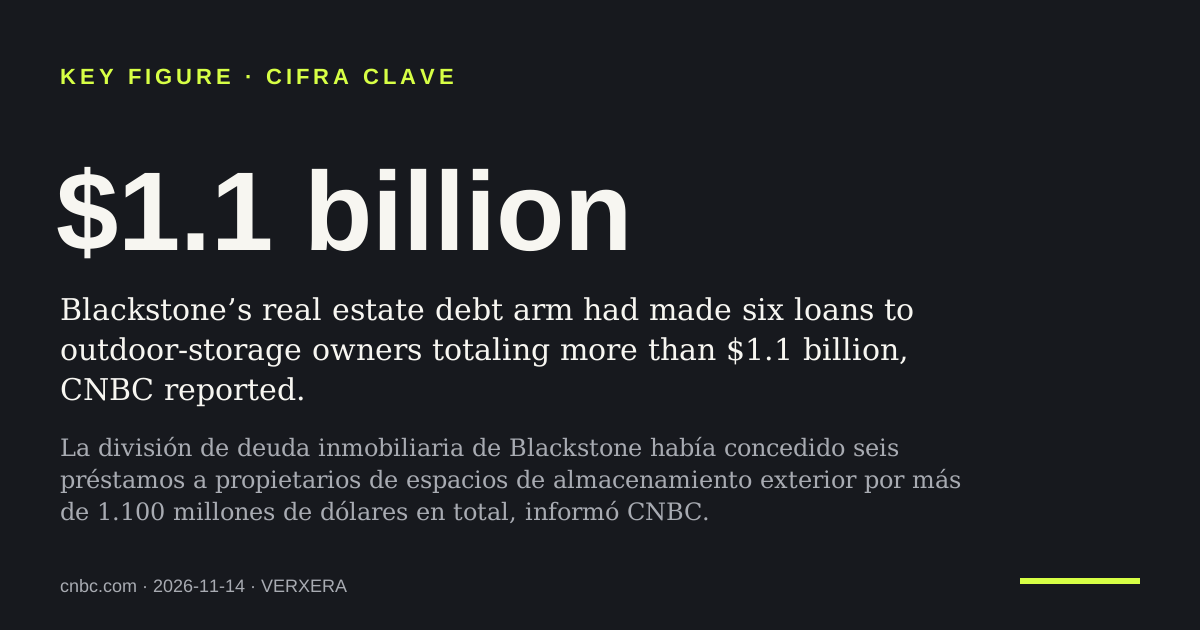
- Blackstone’s real estate debt arm had made six loans to outdoor-storage owners totaling more than $1.1 billion, CNBC reported.
- Newmark Research and Alterra IOS data cited by CNBC showed industrial outdoor-storage rents roughly doubled across eight major markets between 2020 and the third quarter of 2026.
- Average monthly rent per usable acre rose 103.5% to nearly $11,000 over that period, according to the data cited by CNBC.
- Traditional industrial space, including indoor warehouses, recorded a 66% rent increase over the same period, according to the data cited by CNBC.
- CNBC reported rent increases of 204% in Baltimore, 159% in Houston and 148% in Norfolk. Outdoor storage in South Florida and Savannah trailed traditional industrial space.
03
Analysis
CNBC’s account describes two distinct forms of institutional participation: Brookfield’s acquisition of properties and Blackstone’s loans to owners. These transactions sit alongside a multiyear rent comparison, not a measure of investment returns. The eight-market scope and differing local results limit how broadly the average can describe individual properties.
04 · VERXERA view
Editorial opinionVERXERA opinion: The strongest conclusion from CNBC’s report is that substantial institutional commitments accompany a pronounced, uneven rise in outdoor-storage rents. From 2020 through the third quarter of 2026, average monthly rent per usable acre increased 103.5% to nearly $11,000, compared with 66% rent growth for traditional industrial space. Read alongside Brookfield’s $1.2 billion acquisition of Peakstone and Blackstone’s more than $1.1 billion in loans, those figures show why rent trends and the form of capital participation belong in the same account. They do not establish investment returns or show that institutional activity caused the increases. This account rests on CNBC’s report alone. The comparison warrants deeper source reading for sector-level context, not a conclusion about any particular property.
This is VERXERA’s editorial interpretation, separated from the facts and analysis above. The reader keeps the final judgment.
05
Counterevidence and limits
The reported advantage was not universal: CNBC said outdoor storage in South Florida and Savannah trailed traditional industrial space.
06
Known uncertainties
The methodology behind the Newmark Research and Alterra IOS rent figures is not stated.
En este artículo
- BXBlackstone · NYSE$120.19▲ 1.39% día
Precios al publicar, 14 nov, 1:05 p.m. ET, de Twelve Data. El cambio del día se compara con el cierre anterior. No es asesoría de inversión.
01
Lo que importa
Las rentas del almacenamiento industrial al aire libre se duplicaron aproximadamente en ocho grandes mercados de Estados Unidos entre 2020 y el tercer trimestre de 2026, superando el aumento de los espacios industriales tradicionales, según CNBC. Su reportaje también detalla la adquisición de inmuebles de Brookfield y los préstamos de Blackstone a propietarios de estos espacios.
02
Hechos verificados
- CNBC publicó el reportaje el 14 de noviembre de 2026.
- Según CNBC, Brookfield destinó 1.200 millones de dólares a adquirir Peakstone Realty Trust y retirarla de bolsa, en una operación completada en mayo de 2026. La cartera incluía más de 70 propiedades industriales, en su mayoría terrenos de almacenamiento al aire libre.
- La división de deuda inmobiliaria de Blackstone había concedido seis préstamos a propietarios de espacios de almacenamiento exterior por más de 1.100 millones de dólares en total, informó CNBC.
- Los datos de Newmark Research y Alterra IOS citados por CNBC mostraron que las rentas del almacenamiento industrial al aire libre se duplicaron aproximadamente en ocho grandes mercados entre 2020 y el tercer trimestre de 2026.
- La renta mensual promedio por acre utilizable aumentó un 103,5%, hasta casi 11.000 dólares durante ese período, según los datos citados por CNBC.
- Los espacios industriales tradicionales, incluidas las naves de almacenamiento, registraron un aumento de las rentas del 66% durante el mismo período, según los datos citados por CNBC.
- CNBC informó de aumentos de las rentas del 204% en Baltimore, del 159% en Houston y del 148% en Norfolk. El almacenamiento exterior en el sur de Florida y Savannah quedó por debajo de los espacios industriales tradicionales.
03
Análisis
El reportaje de CNBC describe dos formas distintas de participación institucional: la adquisición de propiedades por Brookfield y los préstamos de Blackstone a propietarios. Estas operaciones acompañan una comparación de rentas de varios años, no una medición de rendimientos de inversión. El alcance de ocho mercados y las diferencias locales limitan la representatividad del promedio para inmuebles individuales.
04 · Opinión VERXERA
Opinión editorialOpinión de VERXERA: La conclusión más sólida del reportaje de CNBC es que importantes compromisos institucionales acompañan un aumento pronunciado y desigual de las rentas. Entre 2020 y el tercer trimestre de 2026, la renta mensual promedio por acre utilizable creció un 103,5%, hasta casi 11.000 dólares, frente al 66% de los espacios industriales tradicionales. Junto con los 1.200 millones de dólares que Brookfield destinó a adquirir Peakstone y los préstamos de Blackstone por más de 1.100 millones, las cifras justifican examinar conjuntamente las rentas y las formas de participación del capital. No establecen rendimientos ni demuestran que la actividad institucional causara los aumentos. Este relato descansa únicamente en el reportaje de CNBC. La comparación merece una lectura más profunda para entender el sector, no para sacar conclusiones sobre un inmueble concreto.
Esta es la interpretación editorial de VERXERA, separada de los hechos y del análisis anteriores. El lector conserva la decisión final.
05
Contraste y límites
La ventaja señalada no fue universal: CNBC indicó que el almacenamiento exterior en el sur de Florida y Savannah quedó por debajo de los espacios industriales tradicionales.
06
Incertidumbres conocidas
No se detalla la metodología de las cifras de rentas de Newmark Research y Alterra IOS.