01
What matters
The IRS announced higher standard deductions and child tax credit amounts for tax year 2027. The adjustments generally apply to returns filed in 2028, distinguishing the tax year covered from the year taxpayers generally file.
02
Verified facts
- On Nov. 5, 2026, the IRS announced annual inflation adjustments for almost 70 tax provisions for tax year 2027.
- According to the IRS, the tax-year 2027 adjustments generally apply to tax returns filed in 2028.
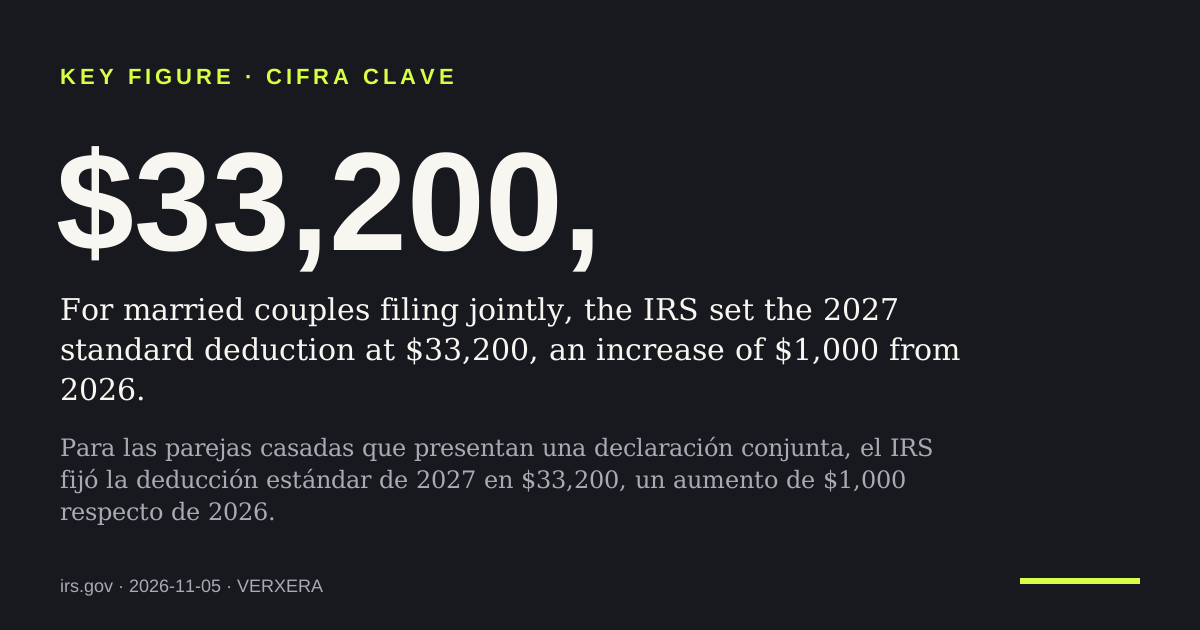
- For married couples filing jointly, the IRS set the 2027 standard deduction at $33,200, an increase of $1,000 from 2026.
- The IRS said the standard deduction for single taxpayers and married individuals filing separately rises to $16,600 for tax year 2027.
- For heads of households, the IRS set the tax-year 2027 standard deduction at $24,925.
- The IRS said the maximum child tax credit for 2027 is $2,300, up $100 from 2026. Up to $1,800 may be refundable, also an increase of $100 from 2026.
03
Analysis
Scope and limits: The standard deduction figures distinguish filing categories, while the child tax credit figures distinguish the maximum credit from the amount that may be refundable. These are separate amounts, not interchangeable measures of a taxpayer’s result. The announcement covers almost 70 provisions; the deduction and credit amounts highlighted here represent only part of that scope. The general filing year is 2028, not 2027.
04 · VERXERA view
Editorial opinionVERXERA opinion: The IRS announcement establishes a concrete increase in the listed deduction and credit amounts, rather than a quantified result for individual taxpayers. For tax year 2027, the joint standard deduction rises by $1,000 to $33,200, while the maximum child tax credit increases by $100 to $2,300 and the potentially refundable amount rises by $100 to $1,800. Connecting these figures matters because the release describes different tax provisions with different stated limits; it does not present one uniform benefit amount. Its strongest limitation for an individual reader is that the announced amounts do not establish that reader’s tax outcome. The bounded takeaway is that deeper source reading is relevant to the applicable filing category and credit, not to assuming a particular refund.
This is VERXERA’s editorial interpretation, separated from the facts and analysis above. The reader keeps the final judgment.
05
Counterevidence and limits
The IRS describes the child tax credit as a maximum and says that up to $1,800 may be refundable, not that every taxpayer receives those amounts.
06
Known uncertainties
The general statement that these adjustments apply to returns filed in 2028 does not identify a specific filing deadline.
01
Lo que importa
El IRS anunció mayores deducciones estándar e importes del crédito tributario por hijos para el año tributario 2027. Los ajustes generalmente se aplican a declaraciones presentadas en 2028, por lo que debe distinguirse el año tributario del año en que generalmente se presenta la declaración.
02
Hechos verificados
- El 5 de noviembre de 2026, el IRS anunció ajustes anuales por inflación para casi 70 disposiciones tributarias correspondientes al año tributario 2027.
- Según el IRS, los ajustes del año tributario 2027 generalmente se aplican a declaraciones de impuestos presentadas en 2028.
- Para las parejas casadas que presentan una declaración conjunta, el IRS fijó la deducción estándar de 2027 en $33,200, un aumento de $1,000 respecto de 2026.
- El IRS indicó que la deducción estándar para contribuyentes solteros y personas casadas que presentan declaraciones por separado aumenta a $16,600 para el año tributario 2027.
- Para quienes declaran como cabeza de familia, el IRS fijó la deducción estándar del año tributario 2027 en $24,925.
- El IRS indicó que el crédito tributario máximo por hijos para 2027 es de $2,300, un aumento de $100 respecto de 2026. Hasta $1,800 pueden ser reembolsables, también un aumento de $100 respecto de 2026.
03
Análisis
Alcance y límites: Los importes de la deducción estándar distinguen categorías de declaración, mientras que los del crédito tributario por hijos distinguen el crédito máximo del importe que puede ser reembolsable. Son cantidades distintas, no medidas intercambiables del resultado tributario de una persona. El anuncio abarca casi 70 disposiciones; las deducciones y el crédito destacados aquí representan solo parte de ese alcance. El año general de presentación es 2028, no 2027.
04 · Opinión VERXERA
Opinión editorialOpinión de VERXERA: El anuncio del IRS establece un aumento concreto de las deducciones y del crédito indicados, no un resultado cuantificado para cada contribuyente. Para el año tributario 2027, la deducción estándar conjunta sube $1,000, hasta $33,200; el crédito tributario máximo por hijos aumenta $100, hasta $2,300, y el importe potencialmente reembolsable sube $100, hasta $1,800. Relacionar estas cifras importa porque el comunicado describe disposiciones distintas con límites diferentes, no un beneficio uniforme. Su principal limitación para cada lector es que los importes anunciados no determinan su resultado tributario personal. La conclusión acotada es que una lectura más detallada de la fuente resulta pertinente para la categoría de declaración y el crédito correspondientes, no para dar por supuesto un reembolso determinado.
Esta es la interpretación editorial de VERXERA, separada de los hechos y del análisis anteriores. El lector conserva la decisión final.
05
Contraste y límites
El IRS describe el crédito tributario por hijos como un máximo y señala que hasta $1,800 pueden ser reembolsables, no que todos los contribuyentes reciban esos importes.
06
Incertidumbres conocidas
La indicación general de que estos ajustes se aplican a declaraciones presentadas en 2028 no identifica una fecha límite específica de presentación.