01
What matters
CNBC reported that nearly nine in ten voters considered the cost of living a crucial or major factor in their congressional vote. Separately, PBS NewsHour reported Amy Walter’s account of polling in which 63% attributed higher prices to Trump’s policies.
02
Verified facts
- According to CNBC, nearly nine in ten voters in the CNBC Voter Poll said the cost of living was a crucial or major factor in their vote for Congress.
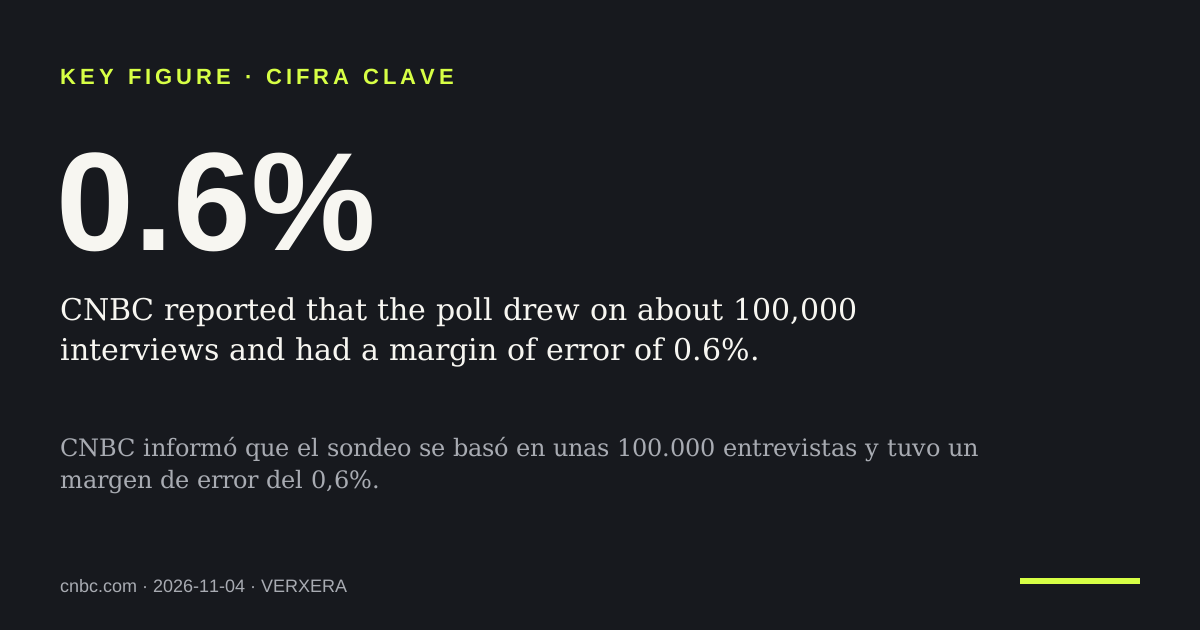
- CNBC reported that the poll drew on about 100,000 interviews and had a margin of error of 0.6%.
- In a PBS NewsHour interview published November 4, 2026, Amy Walter said 63% of voters attributed higher prices to Trump’s policies.
- In the same PBS NewsHour interview, Walter said 37% of voters attributed higher prices to some other reason.
03
Analysis
The reporting addresses two distinct questions: how important living costs were to congressional voters, according to CNBC, and whom voters held responsible for higher prices, according to Walter on PBS NewsHour. These findings describe stated priorities and beliefs. They do not measure the contribution of particular policies to prices. CNBC’s interview count and reported margin of error describe its poll, not an independent economic test of voters’ explanations.
04 · VERXERA view
Editorial opinionVERXERA opinion: The evidence-led conclusion is that cost concerns and responsibility for higher prices should be read together, while remaining distinct. CNBC’s finding that nearly nine in ten congressional voters considered living costs crucial or major establishes the reported breadth of concern. In PBS NewsHour’s November 4, 2026 interview, Walter’s 63% versus 37% split describes how voters assigned responsibility. The reports emphasize different questions—issue importance and perceived cause—not competing estimates of the same measure. That connection matters because concern about prices is not itself agreement about their cause. The strongest limitation is that voters’ attribution does not establish economic causation. Deeper source reading is worthwhile for understanding these reported attitudes, not for treating them as a measured policy effect.
This is VERXERA’s editorial interpretation, separated from the facts and analysis above. The reader keeps the final judgment.
05
Counterevidence and limits
Walter’s account on PBS NewsHour includes a material counterpoint: 37% attributed higher prices to some other reason, rather than Trump’s policies.
06
Known uncertainties
The reported responses do not resolve how much particular policies contributed to higher prices or what specific explanations the 37% had in mind.
01
Lo que importa
CNBC informó que casi nueve de cada diez votantes consideraron el costo de vida un factor crucial o importante en su voto al Congreso. Por separado, PBS NewsHour difundió la descripción de Amy Walter de un sondeo en el que el 63% atribuyó los precios más altos a las políticas de Trump.
02
Hechos verificados
- Según CNBC, casi nueve de cada diez votantes del CNBC Voter Poll dijeron que el costo de vida fue un factor crucial o importante en su voto al Congreso.
- CNBC informó que el sondeo se basó en unas 100.000 entrevistas y tuvo un margen de error del 0,6%.
- En una entrevista de PBS NewsHour publicada el 4 de noviembre de 2026, Amy Walter dijo que el 63% de los votantes atribuyó los precios más altos a las políticas de Trump.
- En la misma entrevista de PBS NewsHour, Walter dijo que el 37% de los votantes atribuyó los precios más altos a alguna otra razón.
03
Análisis
La información aborda dos preguntas distintas: qué importancia tuvieron los gastos cotidianos para los votantes al Congreso, según CNBC, y a quién responsabilizaron por los precios más altos, según Walter en PBS NewsHour. Los resultados describen prioridades y creencias declaradas. No miden la contribución de políticas concretas a los precios. El número de entrevistas y el margen de error que publicó CNBC describen su sondeo, no una prueba económica independiente de las explicaciones de los votantes.
04 · Opinión VERXERA
Opinión editorialOpinión de VERXERA: La conclusión respaldada por los datos es que la preocupación por los costos y la atribución de responsabilidad deben leerse juntas, sin confundirlas. El resultado de CNBC —casi nueve de cada diez votantes al Congreso consideraron crucial o importante el costo de vida— establece la amplitud declarada de esa preocupación. En PBS NewsHour, el 4 de noviembre de 2026, Walter describió un reparto del 63% frente al 37% sobre la responsabilidad. Los reportes destacan preguntas diferentes: importancia del tema y causa percibida, no estimaciones contrapuestas de una misma medida. La conexión importa porque preocuparse por los precios no implica coincidir sobre su causa. La principal limitación es que esa atribución no demuestra causalidad económica. Profundizar en las fuentes sirve para comprender estas actitudes, no para interpretarlas como un efecto medido de las políticas.
Esta es la interpretación editorial de VERXERA, separada de los hechos y del análisis anteriores. El lector conserva la decisión final.
05
Contraste y límites
El relato de Walter en PBS NewsHour incluye un contrapunto relevante: el 37% atribuyó los precios más altos a alguna otra razón, no a las políticas de Trump.
06
Incertidumbres conocidas
Las respuestas descritas no resuelven cuánto contribuyeron determinadas políticas a los precios más altos ni qué explicaciones concretas tenía en mente ese 37%.