01
What matters
U.S. consumer prices rose more slowly in October 2026, while core inflation held at the level CryptoSlate reported Waller had linked to considering a larger December rate increase. The release therefore combines a slower overall monthly price increase with an unchanged core reading—not an announced policy decision.
02
Verified facts
- CryptoSlate published its report on November 10, 2026, at 4:09 pm GMT.
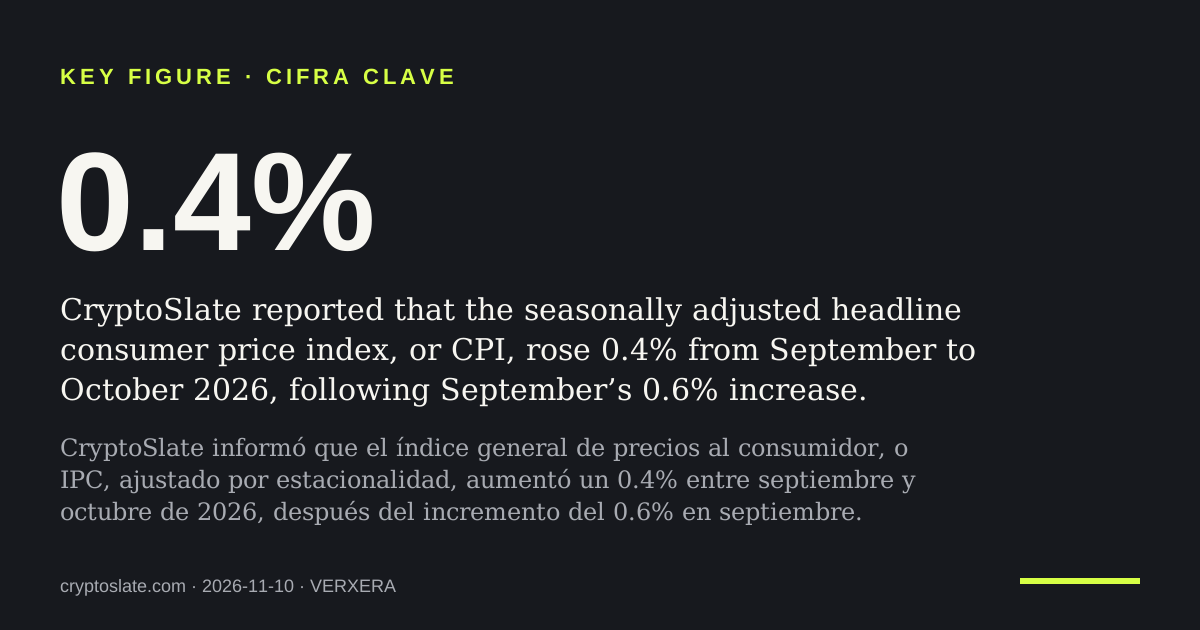
- CryptoSlate reported that the seasonally adjusted headline consumer price index, or CPI, rose 0.4% from September to October 2026, following September’s 0.6% increase.
- CryptoSlate reported that October core CPI, which excludes food and energy, rose 0.3%, marking the third consecutive month at that rate.
- According to CryptoSlate, before the CPI release Waller said a report resembling the preceding two monthly readings, with core CPI around 0.3% or higher, would warrant considering a 50-basis-point December rate increase. This was his conditional view, not a Federal Open Market Committee decision.
- Cointelegraph reported October monthly headline CPI of 0.4%, against economists’ forecast of 0.3%, and core inflation of 0.3%, against an expected 0.2%.
- Unchained reported that neither headline nor core CPI had an October 12-month inflation rate because October 2025 prices were not surveyed during the 2025 funding lapse.
03
Analysis
The comparisons answer different questions. CryptoSlate’s figures show headline inflation slowing relative to September, while core inflation remained unchanged. Cointelegraph’s forecast comparison shows both October readings exceeding expectations. Slower inflation means prices increased less quickly, not that prices fell. Matching the approximate core reading in Waller’s earlier condition does not turn that condition into a policy commitment.
04 · VERXERA view
Editorial opinionVERXERA opinion: This release supports a distinction between slower headline inflation and improvement across inflation measures. CryptoSlate reports that monthly headline CPI slowed from September’s 0.6% to 0.4% in October 2026, while core CPI remained at 0.3% for a third month. Cointelegraph reports that those October readings exceeded forecasts of 0.3% and 0.2%, respectively. Together, these comparisons explain why the headline slowdown does not settle the policy question raised by Waller’s conditional case for considering a 50-basis-point December increase. His remarks preceded the release and expressed a conditional personal view, not an FOMC decision. The bounded takeaway is to read October as slower overall monthly inflation without a corresponding core slowdown; closer attention to the policy argument is warranted only with that distinction intact.
This is VERXERA’s editorial interpretation, separated from the facts and analysis above. The reader keeps the final judgment.
05
Counterevidence and limits
The absence of October headline and core annual rates, reported by Unchained, limits the comparison to monthly inflation rather than a combined monthly-and-annual picture.
06
Known uncertainties
Waller’s pre-release condition does not establish his assessment after the release or what the FOMC will decide in December. This report reflects information as of November 10, 2026, at 18:03 UTC; later developments are not covered.
01
Lo que importa
Los precios al consumidor de Estados Unidos aumentaron más lentamente en octubre de 2026, mientras la inflación subyacente se mantuvo en el nivel que, según CryptoSlate, Waller había vinculado a considerar una mayor subida de tasas en diciembre. El informe combina así una menor subida mensual general con una lectura subyacente sin cambios, no una decisión de política monetaria anunciada.
02
Hechos verificados
- CryptoSlate publicó su informe el 10 de noviembre de 2026 a las 4:09 p. m. GMT.
- CryptoSlate informó que el índice general de precios al consumidor, o IPC, ajustado por estacionalidad, aumentó un 0.4% entre septiembre y octubre de 2026, después del incremento del 0.6% en septiembre.
- CryptoSlate informó que el IPC subyacente de octubre, que excluye alimentos y energía, subió un 0.3%, el tercer mes consecutivo con esa tasa.
- Según CryptoSlate, antes de publicarse el IPC Waller dijo que un informe similar a las dos lecturas mensuales anteriores, con un IPC subyacente cercano al 0.3% o superior, justificaría considerar una subida de tasas de 50 puntos básicos en diciembre. Era su postura condicional, no una decisión del Comité Federal de Mercado Abierto.
- Cointelegraph informó que el IPC general mensual de octubre fue del 0.4%, frente al 0.3% previsto por economistas, y que la inflación subyacente fue del 0.3%, frente al 0.2% esperado.
- Unchained informó que no hubo tasas de inflación a 12 meses para el IPC general ni el subyacente de octubre porque no se recopilaron precios de octubre de 2025 durante la interrupción del financiamiento público de 2025.
03
Análisis
Las comparaciones responden a preguntas distintas. Las cifras de CryptoSlate muestran una desaceleración general respecto de septiembre y una inflación subyacente sin cambios. La comparación de Cointelegraph muestra que ambas lecturas superaron las expectativas. Una inflación más lenta significa que los precios aumentaron menos rápidamente, no que bajaron. Coincidir con la lectura subyacente aproximada de la condición anterior de Waller no la convierte en un compromiso de política monetaria.
04 · Opinión VERXERA
Opinión editorialOpinión de VERXERA: Este informe permite distinguir entre una desaceleración general y una mejora del conjunto de indicadores. CryptoSlate informa que el IPC general mensual pasó del 0.6% de septiembre al 0.4% en octubre de 2026, mientras el subyacente permaneció en el 0.3% por tercer mes. Según Cointelegraph, ambas lecturas superaron los pronósticos del 0.3% y el 0.2%, respectivamente. Estas comparaciones explican por qué la desaceleración general no resuelve la cuestión planteada por el argumento condicional de Waller para considerar una subida de 50 puntos básicos en diciembre. Sus declaraciones precedieron al informe y expresaban una postura personal condicional, no una decisión del FOMC. La conclusión acotada es interpretar octubre como una desaceleración mensual general sin una mejora equivalente del subyacente; profundizar en el argumento monetario resulta pertinente solo manteniendo esa distinción.
Esta es la interpretación editorial de VERXERA, separada de los hechos y del análisis anteriores. El lector conserva la decisión final.
05
Contraste y límites
La ausencia de tasas anuales de octubre para el IPC general y el subyacente, señalada por Unchained, limita la comparación a la inflación mensual, sin una perspectiva conjunta mensual y anual.
06
Incertidumbres conocidas
La condición expresada por Waller antes del informe no establece su evaluación posterior ni qué decidirá el FOMC en diciembre. Este informe refleja la información al 10 de noviembre de 2026 a las 18:03 UTC; no abarca acontecimientos posteriores.