01
What matters
Treasury’s November 4, 2026, statement outlines an offering expected to raise approximately $28 billion in new cash. It also sets out expected December and January bill-auction changes and a March 2027 change to the 7-year note’s issuance pattern.
02
Verified facts
- Treasury announced a $125 billion securities offering to refinance approximately $97 billion of privately held notes and bonds maturing November 15, 2026. Its November 4 announcement said the issuance would raise approximately $28 billion in new cash.
- Based on projected borrowing needs, Treasury anticipates maintaining nominal coupon and floating-rate note auction sizes for the next several quarters.
- Treasury expects to reduce shorter-dated bill auction sizes in December 2026, citing projected receipts associated with the mid-December corporate and non-withheld tax date.
- In January 2027, Treasury anticipates increasing auction sizes across the bill curve, based on expected seasonal fiscal outflows.
- Treasury plans to replace monthly new issues of the 7-year note with quarterly new issues and two reopenings. The change begins with the March 2027 new issue, followed by reopenings in April and May.
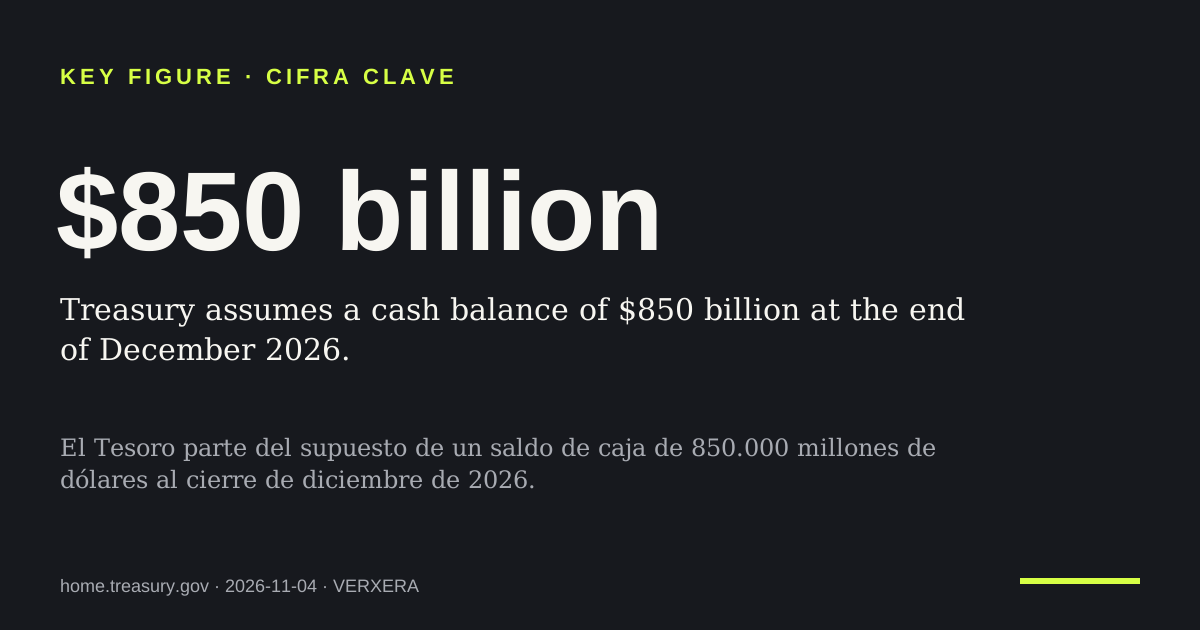
- Treasury assumes a cash balance of $850 billion at the end of December 2026.
- For the upcoming refunding quarter, Treasury estimates that its General Account could peak at $1.025 trillion, plus or minus $50 billion, in late November 2026 and late January 2027.
- For the November 2026–January 2027 quarter, Treasury anticipates buying up to $70 billion in off-the-run securities for liquidity support and up to $25 billion in securities with maturities of 1 month to 2 years for cash management.
03
Analysis
Release scope: The announcement distinguishes expected auction sizes from cash-balance assumptions and anticipated buybacks. The December reductions and January increases concern bills; the expectation of maintained sizes concerns nominal coupon securities and floating-rate notes. These are financing plans, not reported auction or buyback results.
04 · VERXERA view
Editorial opinionVERXERA opinion: Treasury’s announcement is best read as a financing plan with distinct amounts and time horizons, rather than as a report of completed borrowing. The $125 billion November 2026 offering includes refinancing approximately $97 billion, leaving approximately $28 billion in new cash—not $125 billion. Separately, the $850 billion end-December cash assumption and possible $1.025 trillion account peaks, plus or minus $50 billion, in late November and late January describe different points in time. Keeping those distinctions clear matters when interpreting the announcement’s scale. Its strongest limitation is that expectations are not realized results. Deeper source reading is worthwhile for understanding the planned financing sequence, not for establishing eventual auction outcomes.
This is VERXERA’s editorial interpretation, separated from the facts and analysis above. The reader keeps the final judgment.
05
Counterevidence and limits
This report rests on Treasury’s November 4, 2026, refunding statement; the amounts, dates and expectations are Treasury’s own.
06
Known uncertainties
The statement does not specify the amounts of the planned December bill-auction reductions or January increases. Actual buyback purchases remain open: the stated amounts are anticipated maximums, not completed purchases.
01
Lo que importa
El comunicado del Tesoro del 4 de noviembre de 2026 detalla una oferta que prevé captar aproximadamente 28.000 millones de dólares de efectivo nuevo. También contempla cambios en las subastas de letras en diciembre y enero y una modificación del patrón de emisión del título a 7 años desde marzo de 2027.
02
Hechos verificados
- El Tesoro anunció una oferta de valores por 125.000 millones de dólares para refinanciar aproximadamente 97.000 millones en títulos en manos privadas que vencen el 15 de noviembre de 2026. Su anuncio del 4 de noviembre indicó que la emisión captaría unos 28.000 millones de efectivo nuevo.
- Sobre la base de las necesidades de endeudamiento proyectadas, el Tesoro prevé mantener durante los próximos trimestres los montos de las subastas de valores nominales con cupón y de títulos a tasa variable.
- El Tesoro espera reducir los montos de las subastas de letras de vencimiento más corto en diciembre de 2026, citando ingresos previstos vinculados a la fecha tributaria de mediados de diciembre para sociedades e impuestos no sujetos a retención.
- En enero de 2027, el Tesoro prevé aumentar los montos de las subastas en todos los plazos de letras, sobre la base de salidas fiscales estacionales esperadas.
- El Tesoro planea sustituir las nuevas emisiones mensuales del título a 7 años por nuevas emisiones trimestrales con dos reaperturas. El cambio comienza con la emisión de marzo de 2027, seguida de reaperturas en abril y mayo.
- El Tesoro parte del supuesto de un saldo de caja de 850.000 millones de dólares al cierre de diciembre de 2026.
- Para el próximo trimestre de refinanciación, el Tesoro estima que su Cuenta General podría alcanzar máximos de 1.025.000 millones de dólares, con un margen de más o menos 50.000 millones, a finales de noviembre de 2026 y de enero de 2027.
- Para noviembre de 2026–enero de 2027, el Tesoro prevé recomprar hasta 70.000 millones de dólares en valores de emisiones anteriores para apoyar la liquidez y hasta 25.000 millones en valores con vencimientos de 1 mes a 2 años para gestionar la caja.
03
Análisis
Alcance del comunicado: El anuncio distingue los montos esperados de las subastas de los supuestos de caja y las recompras previstas. Las reducciones de diciembre y los aumentos de enero corresponden a letras; la previsión de mantener montos corresponde a valores nominales con cupón y títulos a tasa variable. Son planes de financiación, no resultados de subastas o recompras.
04 · Opinión VERXERA
Opinión editorialOpinión de VERXERA: El anuncio del Tesoro debe leerse como un plan de financiación con montos y horizontes distintos, no como un informe de endeudamiento completado. La oferta de noviembre de 2026 por 125.000 millones de dólares incluye refinanciar unos 97.000 millones: el efectivo nuevo sería de unos 28.000 millones, no de 125.000 millones. Por separado, el supuesto de caja de 850.000 millones al cierre de diciembre y los posibles máximos de 1.025.000 millones, más o menos 50.000 millones, a finales de noviembre y enero corresponden a momentos diferentes. Distinguirlos permite interpretar la escala del anuncio. La principal limitación es que las expectativas no son resultados efectivos. Consultar el documento completo resulta útil para entender la secuencia prevista, no para establecer los resultados finales de las subastas.
Esta es la interpretación editorial de VERXERA, separada de los hechos y del análisis anteriores. El lector conserva la decisión final.
05
Contraste y límites
Este informe se basa en el comunicado de refinanciación del Tesoro del 4 de noviembre de 2026; los montos, las fechas y las expectativas corresponden a sus propias declaraciones.
06
Incertidumbres conocidas
El comunicado no especifica los montos de las reducciones de las subastas de letras previstas para diciembre ni de los aumentos de enero. Los importes efectivos de las recompras siguen abiertos: las cifras indicadas son máximos previstos, no compras completadas.